Ancestral Roofs

"In Praise of Older Buildings"

Wednesday, November 11, 2015

Yes, Minister

Collect all 11!
PEC Court House (first case)

Foundations, that essential Kingston heritage research tool, is a publication of the Frontenac Heritage Foundation. I am a proud member of that organization, having met with representative David Bull some years ago at a heritage event in the limestone city.

Earlier this year, FHF released an issue  dedicated to Sir John A. Macdonald in this 200th birthday year. Volume 42, Number 1 contains several articles pertaining to our first PM's life and times.
family mill at Glenora

One tells the story of Picton's Macdonald Project. The fall issue of County and Quinte Living magazine features an interview with David and  Marilyn Warrick, who led this successful campaign to have a full-size bronze statue of Sir John A. (at the bar - no, the other bar) created by sculptor Ruth Abernathy, and installed in front of the Armouries in downtown Picton.

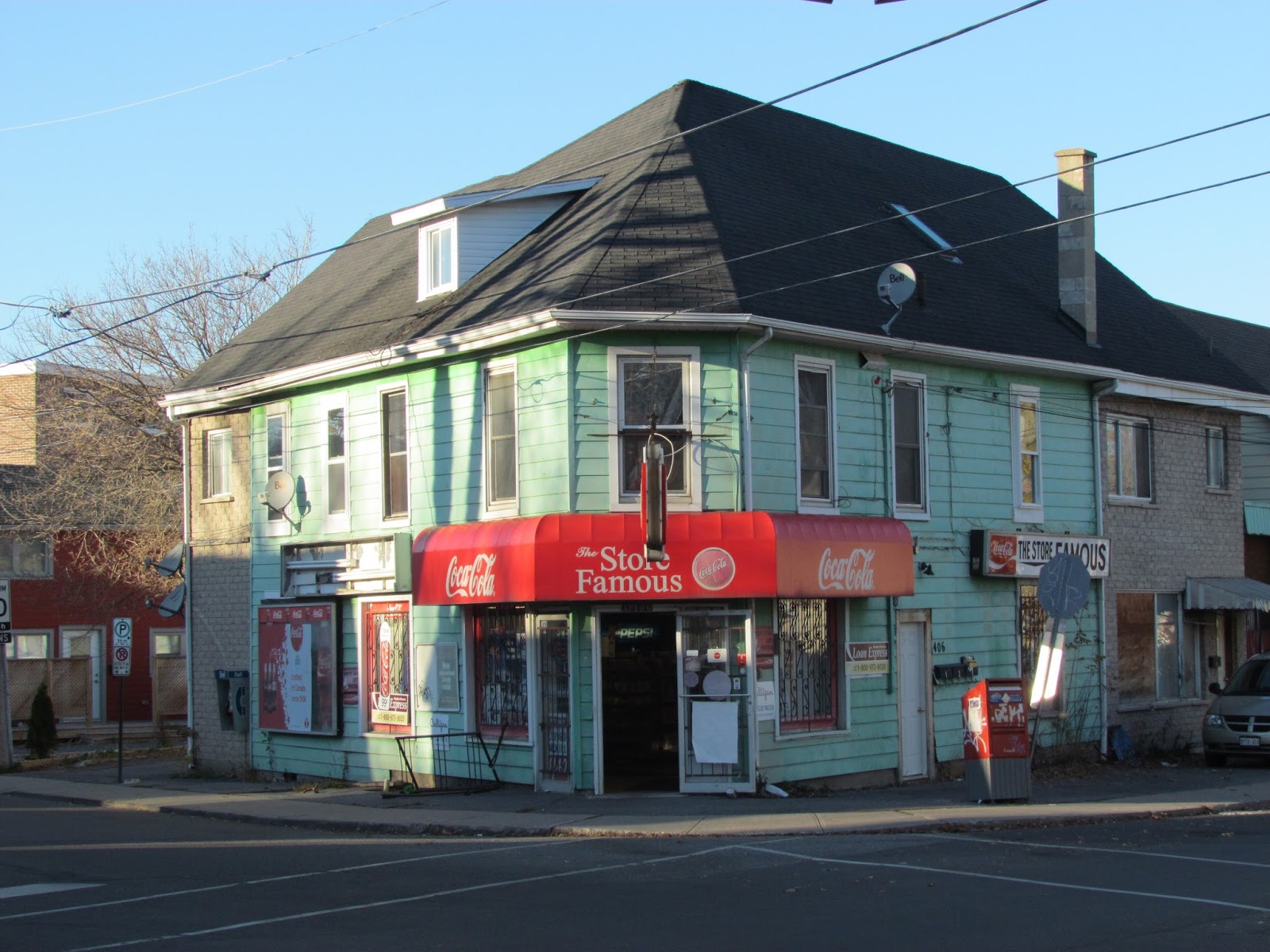
110-112 Rideau Street, originally a single-family dwelling
But the article which keeps drawing me back is a pilgrimage of sorts to all of the buildings associated with our illustrious founder. As the writer so ably explains: "The buildings in Kingston where Macdonald maintained his law practice, provided accommodation for his immediate family and relatives, or were his legal address as an elected official, are well preserved heritage sites, protected by the Ontario Heritage Act. Walking through their doorways is walking in the footsteps of the city's most famous citizen..."

Now, I haven't walked through many of these doorways, but I have stood and reflected in front of several. Now it's back to Kingston to complete the set!

Earlier this week I wandered old North Kingston, and found the c.1810 double stone house in which John A., his mother, father and younger sisters lived during 1935-9. Incidentally, this house was restored by the FHF in 1975/8.

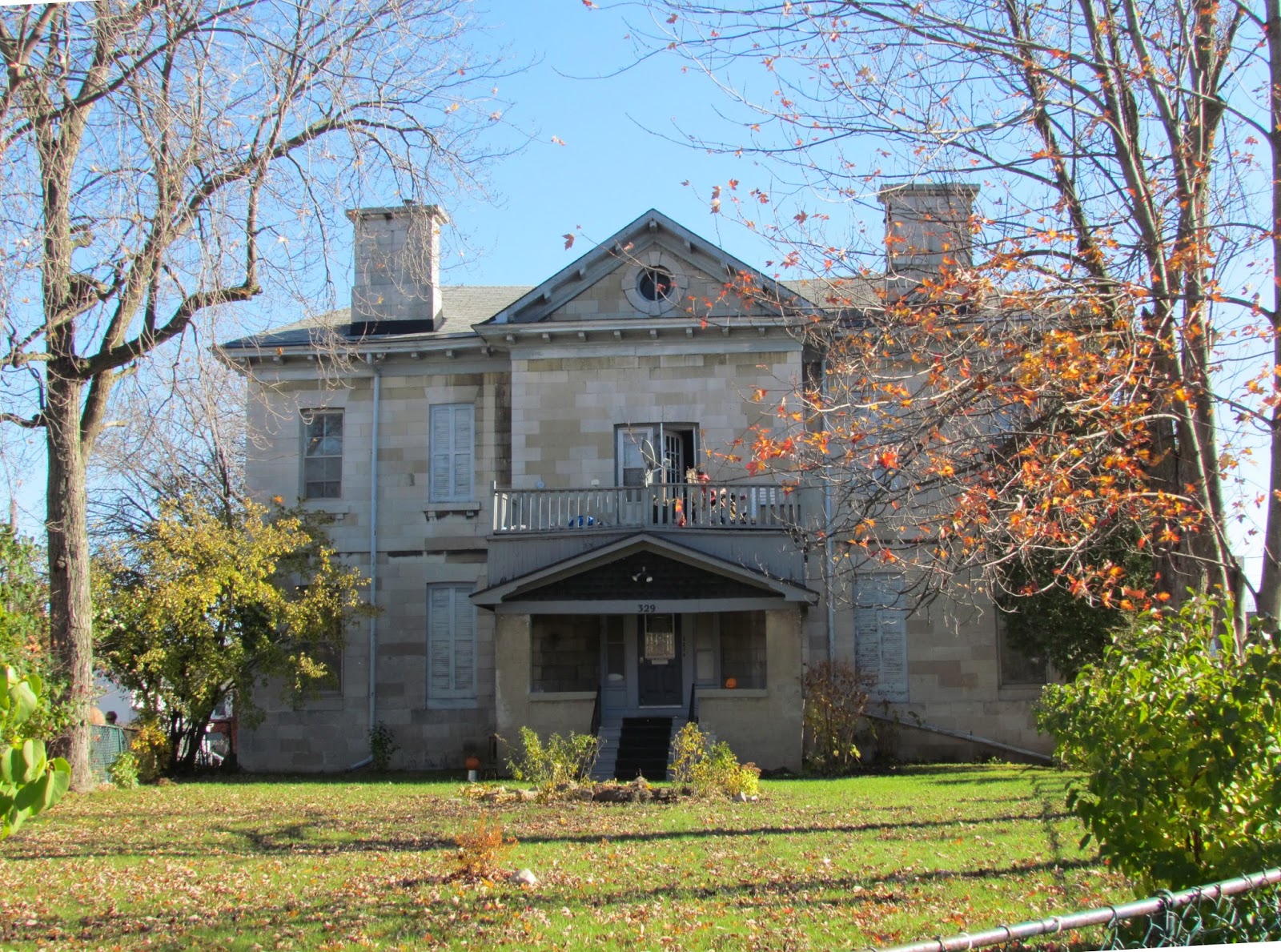
134 Earl Street (1866)
 And over on Earl Street, Sir John A. rented this house for his widowed brother-in-law and his sister. Macdonald seems to have been particularly encumbered with family responsibilities! The poignant story of his first marriage provides a different perspective on the public figure we think we know.

134 Earl Street was also Macdonald's legal residence while he was MP for Kingston, until 1889 (Duffy take note.)

And Bellevue. What can be said about Bellevue, the poster child for the picturesque Italian Villa in Canada? Well, I've said some things. Here, for example. Or you can check the Parks Canada website for what looks like the definitive life story of the man (and the house is a short link away.)
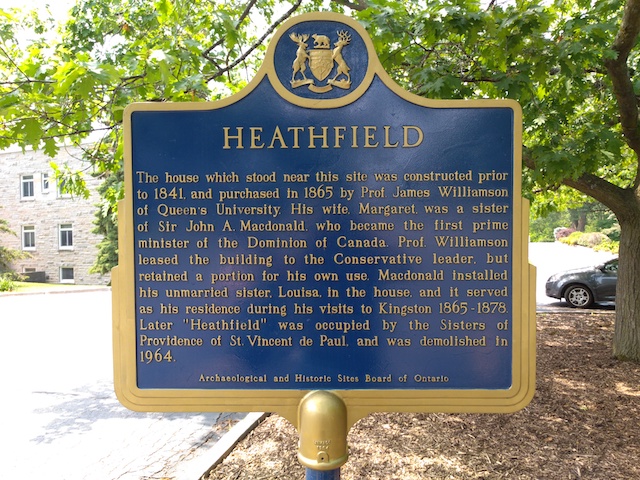
Heathfield
So. Only a few more to capture for the complete set. I will have to settle for archival photo of the c.1841 Heathfield house, as it was demolished in 1964.

And perhaps I can compensate for not yet having photographed his law office at 343 King Street, by affirming that I have enjoyed a pint there on several occasions. For this building now houses Sir John's Public House. I think the great man might have approved.

Tuesday, November 10, 2015

Nary a Rogue to be Seen


This week I have enjoyed two delightful walks around the village of Newburgh. Two, as I wanted to capture its early buildings in their best light, both those facing the morning sun and those inclined toward sunset musings.

Thanks to  my 'new' copy of Rogues' Hollow (Peter John Stokes, Tom Cruickshank and Robert Heaslip; ACO, 1983) I had planned my quest well. Thanks also to the village's small size (though bracingly hilly terrain) I was able to find and capture all of the places I wished to study further.


 And in all those hours of walking, I shared the streets with 3 dog-walkers, and one distinguished gentleman, who would have tipped his hat, I'm sure, had he been wearing one.

 I recently remarked to friend Brenda that I'm a bit like the squirrels, dashing about in the last of the warm fall weather, storing up loads of photos for winter enjoyment. The word 'nuts' did come up in the conversation.

In a village so well documented, and so intriguingly preserved, compulsive photographing is inevitable. Heart-breaking beauty. Remembering always that real early treasure can be found under vinyl and insulbrick, or hiding under signs of neglect or unsympathetic additions.

The distinctive profile of 1850's structures - tall parapet-end townhouses, wide gentle roof pitches, bold Greek revival cornices and returns - and the wonderful use of stone from rubble to fine ashlar make exploring this village an absolute delight. Indeed if anyone had seen me, they might have wondered what that woman was grinning about.

Rogues' Hollow is a scholarly work, examining not just the buildings of the village, but the streetscape, the vegetation and topography, all in the interests of preservation planning. It's filled with scaled plan maps of each neighbourhood.

At the end, A Comparative Pictorial Glossary of Historic Newburgh's Architectural Details and a Glossary round out the feast. I could dine out on this treasure for weeks. Now are we academics or geeks?

The chapter titled Village Analysis: Streetscape and Buildings articulates (for those struck somewhat dumb in their presence) the features that give the village such character: the human scale of the buildings, narrow roadways, natural features (the river, the sloping terrain, open spaces and vegetation.) Focal points and distant views: I get that, now that you point it out. The mix of residential, commercial and industrial buildings - pre-zoning laws. Likely pretty nasty at the time, but picturesque now. Be prepared. I intend to take you back to Newburgh a few more times.

Village Life 'en francais'

A history blog which I greatly enjoy, Spectres of Kingston Past, has a great account of a little known area of Kingston.

Once called Picardville or "the French village," the area's nineteenth century character is described by blogger Francesca Brzezicki in juicy detail:  "...known for its filth and poverty. It was a notorious area, kept afloat by a steady business in alcohol, crime and prostitution." (Follow the link to read the entire post, it's great.)


I first learned of Picardville from a brief mention by Margaret Angus in her classic Kingston architecture work The Old Stones of Kingston (1966.) Ms. Angus was not quite so forthcoming.


In her chapter on 'North Kingston', she mentions the expansion of the city during 1840-50: "houses filled lots from Queen Street to Picardville." That was it. That one line was enough to prompt some on-line bashing about, which was when I found Francesca's blog.


Had to go there myself for the rest of the story. But this unplanned growth does explain the village feel of the place, with streets running higgledy-piggledy, houses sat at odd angles to the road, an inviting park which was once a nastily overcrowded cemetery. Picardville, the French village, is a neighbourhood now, a small village absorbed by the expanding city. I could happily become a villager.

Last week, in some of the last warm golden days of fall, I walked many of the streets of Picardville. A pleasant, well-loved, family-oriented place, with some fine old stone houses cheek by jowl with improved working class frame homes. A few barns, shops, garages. Resonance.


Picardville is bounded by Princess, Division, Raglan and Barrie streets, according to Spectres of Kingston.

 I may have wandered out of bounds for some of these photos, but it sure felt like a village walk to me.

Rock, paper, scissors

 Finally, now that the leaves are off the trees, I have figured out the Napanee River in Newburgh. Well, the map on the interpretive panel outside the doctor's clinic helped.

In its industrial heyday there were 13 mills along the banks of the Napanee and Little Napanee rivers in the village. In actual fact, the centre of the village is an island between the two waterways. The bridges offer lovely invitations to time-travel.
traces of the dam below...

Lots of limestone here. Built homes and shops and factories. Back when manufacturing was done by more people and fewer machines.

...Hooper's Mill
Sadly, the 1856 railway bypassed the town (death-knell for early towns and villages) and in 1863 Napanee became the county seat.

Then in 1887 fire destroyed a large section. The good news in all of this is that time stopped in a way, and a number of 1850 era homes and commercial buildings still stand, many in fine shape, to tell the early story

On my way east along Earl Street toward the cemetery to pay my respects to the pioneer industrialists, I came upon an exquisite property below road grade, its manicured lawns spreading out along the river and a tiny creek, beneath towering trees. A modern waterfront home, a barn and a commercial apiary rounded out the picture. Village life, wot?

What I loved about the carefully tended property was its limestone ruins. Among them, the owners have arranged a collection of milling machinery bits among the garden plantings. Wouldn't I love a visit? Maybe I will need honey on my next visit. Or I might attend Art Among the Ruins next June, mightn't I?

The ruins are the last traces of the 1872 Newburgh Paper Mill of John Thompson (1837-1920) according to the OHF plaque at the corner of Main and Factory Streets.

As I headed homeward along Co.Rd. 1, I noted steam billowing from Strathcona Paper Mill, just south along the same river. It's an efficient green manufacturer of box-board. Turns out the modern facility shares some family history. Turns out John Thompson built a paper mill here at Napanee Mills (now Strathcona) the year after the Newburgh plant, in 1873.


And if you're the least curious about the etymology of the word manufacture, and in deference to the workers of Newburgh who once put their shoulders to the wheels of industry, I offer this link.

Wednesday, November 4, 2015

On Raglan Road on an Autumn Day...

Today I had a perfect fall wander through the wandering streets of the village once called Picardville, in the  Raglan Road and Division Street area of Kingston. It is a delight of tiny streets bending and branching, cul-de-sacs and one-ways. Of fine old stone houses with parapet walls, newer infills, gentrified older homes, plain frame working class cottages, and a few old places that could have been here from the beginning - the core of the old village.

Picardville, according to Margaret Angus. Or French town? Residents Mary and Steve have heard it called that. Now its just one of the charming neighbourhoods of Kingston.

This is Skeleton Park. Now McBurney Park, it has some old stories to tell. Lots of tales await. Once the perfect weather ends and my camera and I come off the road.


Tuesday, November 3, 2015

Deseronto Love

I spent several hours this afternoon in Deseronto. Now Deseronto and I haven't always been on the best of terms. Last February, leaving the truly lovely O'Connor Tea Room, I had an unpleasant snow day contretemps with a speeding SUV, which left my little travelling companion Missy FIT a write-off. Fortunately, nothing even close happened to my two human companions, who continue to be wonderful friends.

Nevertheless, I love Deseronto. More so in the fall. When it's 17 degrees and the maple trees persist in holding onto their leaves, setting the whole town aglow. I walked most of the town. Talked to two lovely men who loved their town, and knew their history. Listened for resonance as I searched for the town's industrial past. There's lots more to come about Deseronto, once I have spent more time on the town's outstanding Archives website, and visited with their energetic and creative archivist Amanda Hill in person.
love

But for now. A little find from my lovely afternoon in this often under-rated village. Incidentally, if you have not read Frances Itani's novels based in Deseronto, you are missing out on some great local stories. Frances Itani's Deafening brings into sharp focus the lives of students at Belleville's School for the Deaf prior to 1920. Her recent novel Tell is based in Deseronto (and the trenches of WWI, both real, and persisting after the return home of the Dominion's young soldiers.) All stories based in real people living real lives in the village.

For now, a lovely piece of garden art in front of one of the village's houses sums up how I feel about my day, and about Deseronto.

Monday, November 2, 2015

Look back, look way back

 I've written about cheese factories before. Not sure I've come up with anything more about the growth and decline of the industry, since then, but I want to share this one.

On Sunday I photographed it,  beside Weller's Bay just north of Consecon, as we walked a section of the Millennium Trail from Salem to Blakely Road. I would like to have taken more shots, but the resident dog joined the tour at that point, and seemed agitated at my interest in his property.
The place still has the characteristic tall roof and the covered canopy loading/offloading bay. The owners of the property have enriched its history with a fascinating collection of found objects nailed to the wall - I didn't shoot that bit, as it felt like invading their home space.

It was intriguing, seeing the building from the slightly different perspective of the old rail trail; it has just always been there as we headed toward Consecon and places south along the highway. Seeing it again launched me into some time travel. We all know that early days saw shipping and then the railway as the way out for Prince Edward County's wealth of  produce. The factory's proximity to the tracks leads me to thinking about the activity that must have take place right here, in this neat and quiet spot.

"The dog trots freely" ~ Ferlinghetti
Prince Edward County: An Illustrated History (Campbell, Davies & Robertson, County Magazine Printshop 2009) is one of my go-to local history resources. Gerald Ackerman's  book The History of Cheesemaking in Prince Edward County forms the basis for one of the articles. Think it's time I found his book and travelled back to
the heyday of cheese in the early 1870's.
And County Canners by Douglas A. Crawford, also. As a farm girl, my life was connected to these industries (but only peripherally, as part of "what does your dad do for a living?")


Walking along the rail trail past the Consecon feed mill and its insulbrick clad freight shed suggested yet another history quest. Many of these structures still stand, but they are pretty circumspect about how much history they impart. Resonance, in large measure. How I wish our dad were still here to tell some tales.