Ancestral Roofs

"In Praise of Older Buildings"

Wednesday, October 14, 2015

Porchfest - Come for the Fest, Stay for the Porches

Porchfest opens on Glanmore's porch
This little video popped up on my FB this morning. It celebrates a friendly community event in Belleville's Old East Hill area, in which we participated a couple of weeks ago. Porchfest. Seventh annual. The event was started by a couple who lives in the area, and has since been taken over by a service club. Porchfest features area musical groups, duos, singles performing al fresco, on residents' porches. By prearrangement, of course. A map is handed out at the opening, which takes place at 'my' house, Glanmore; the map's a treasure hunt of music, chance encounters with friends, kids, dogs, bicycles, sun, and oh yes, the houses of Belleville's lovely OEH.


Our first stop was at the corner of Queen and Dufferin. Great duo, and an opportunity to have a close look at a simple flat roofed prairie style home (one in a row of three!) which I've long admired. I enthused to Denis; as it turns out out we were standing beside Barry, the home-owner. He was able to shed some light on the modernist homes of the OEH - finally! Barry explained the unique features of the trio of homes, including the radiant heat system which keeps him in bare feet all winter.


Who was the architect? urged I, sensing at long last a breakthrough in the mystery of the scattering of moderne and prairie inspired homes in the immediate area; Dufferin seems to be the epicentre. Barry astonished me by explaining that to his knowledge the 'architects' were high school students in a design competition.
Further on down the street, I spoke with a woman standing in front of yet another example of the style. She lives across the street, in a slightly altered version of the flat-roofed homes. In a neighbourly gesture, she fetched her brother David (and pen and paper) who told me the whole story. Music of the very good group 'Tuesday Night Music Club' floated past, as I scribbled notes.

According to Dave, who lived for years in one of the stucco houses, the designer of these and several similar ones, was Doug Mews (now I may not have the spelling correct; do get in touch if you know more.)
Dufferin at Victoria - same builder I wonder?
Doug was a drafting teacher at Belleville Collegiate Institute. During summer holidays in the 1940s, he designed and built a number of homes in the area. All featured flat roofs, wide eaves and the simplified style of Frank Lloyd Wright and the Prairie School.

And remarkably, they also featured radiant heat, passive solar design, concrete floors. These three houses are of cement block construction, smoothly stuccoed. Doug explained that the interior walls were sheathed in 1 inch thick redwood applied over cardboard and foil insulation.

Now let's see. What did I accomplish on my summer break?

Monday, October 12, 2015

Johnny I Hardly Knew Ye

SJW - the main school built 1920s

original residence building 1914
 For twelve years of my career I worked on the lovely campus of the Sir James Whitney School for the Deaf. For twelve years my energies were focussed on the needs of students and staff of a highly specialized school. For twelve years, the exquisite late c19/early c20 buildings were the background of my life...and as background goes, they were seldom given the attention they deserve.

the other residence, facing it across a wide lawn
Not long ago I visited the campus with my architecture mentor and friend, Shannon (she of the Ontario Architecture website) and two lovely friends, Bob and Michelle. Shannon's a good person to have along on a junket, no?

Through their eyes, and through the luxury of spending focussed time in late August before the place came to life for the start of school,  I saw these lovely academic buildings, and the fine historic campus of old trees and heritage plaques, as if for the first time.

the Principal's house 1877
I admired the collegiate Gothic main school building, its dignified doorways and medieval decorative elements, without ever once wondering what was that skirmish at the front of the line, why a student appeared unhappy or isolated, how to meet a paperwork deadline, or resolve a difficult issue.

The day we visited was dull; I returned a few days later, and  had another wander around campus. The huge property was still abandoned, warmed by late afternoon sun pouring like treacle down the west-facing building facades. School was scheduled to start a few days later.  And that reality (for others) didn't intrude on my enjoyment for a second.

Nic Lambooy, an architect whose work I come across occasionally in local architectural heritage documents, wrote a description of the early buildings on the Sir James Whitney school campus.


I've stood in this bay with a celebratory glass


I've used some some of his comments about the buildings here. The Superintendent's house (as we all called it, although none of their ilk ever resided there in my era) was built in the 1870's for the Principal. Just this summer, the Gothic revival wooden barge boards, finial and pendant have been repaired, and the elaborate hood mould above the windows restored and painted. The segmental arches above the vertically proportioned windows are curious, repainted bright white evoking the eyebrows of a surprised senior administrator.

The main building of the school was built in the 1920's, Collegiate Gothic style, an eclectic style with Medieval presence, and detailing. The ivy clambering over the walls is picture perfect. This school was built in front of a previous building, which was then demolished. The materials are c20 -  manufactured brick, reinforced concrete and concrete masonry work (we had a long debate about the mouldings around the doors - stone or concrete? - not knowing the date of construction, and not finding a datestone anywhere.)


Three are lots of dramatic Tudor elements, such as the flattened arch of the main entrance, the cross-shaped Gothic windows (based, Nic reports, on French Croisee windows), buttresses and towers. Late Gothic ogee arches.  Partly crenellated parapets.
those mouldings - are they stone or concrete?
centre tower - baronial, don't you think?
buttresses and hood mouldings

main entrance. Impressed yet?

The school was originally named the Ontario Institution for the Education and Instruction of the Deaf and Dumb (not a pejorative then) in 1870. The current school opened in 1923 as OSD, the name changing to Sir James Whitney School for the Deaf in 1974.

This year is the 145th anniversary for the school. There will be tours of the school's historic art collection and architecture. A history of SJW written by colleagues Donna Fano and Clifton Carbin is due to be released soon. Stay tuned.

The school website contains information about SJW, school activities and curriculum for deaf students. You can view a welcome message in American Sign Language by Principal Janice Drake here.

every classroom window should have hood mouldings

a neoclassical anomaly in an adjacent abandoned building


Sanctuary

On a recent wander around old Kingston we came upon St. Andrew's Scotch Presbyterian
church. The first church on the site was built in 1820 with funds raised by the Presbyterian Society of Kingston, the Scottish Presbyterians of the day taking dour umbrage with the Church of England's assumption that it was to be the only church hatching, matching and dispatching. The gentlemen who had forged the Canada Act (1791) deemed the   C of E  the official church, and granted one-seventh of all land as Clergy Reserves. To see what trouble that caused, read The Rebels of Hastings by Betsy Dewar Boyce or any of a number of fine histories of the Rebellion of 1837.

The plans for the development of Upper Canada were clear. The new country was to be modelled after England's privileged landed Church of England-adhering aristocracy.
 A Governor sent from England, A Legislative Council, similar to the House of Lords (there were plans to make the appointments hereditary), an appointed Executive Council. Massive land grants were given to ex-military officers, with a class structure trickling down to merchants, farmers and labourers, parallel that of the home country.

The Family Compact. A few wealthy educated men took all the positions of power and appointed their relatives. Entitlement. Elitism. It's not something new. But I digress.

I tried to take a few photos of the church, conscious of keeping people out of the frame, to protect their privacy, and because it was all about the Romanesque Revival detailing.
As cold as we were, the folks huddled on the steps looked even more so. I wondered if it were just a gathering place in the sun, or if the small crowd was gathering for a hot meal, or a sack lunch.

It reminded me how so many of the downtown churches have taken on the role of feeding the hungry of their neighbourhoods. I just wrote an article about Bridge Street United Church in Belleville. For nearly 20 years they have had an active 'food ministry,' their aim "to fill tummies and warm souls." Thinking back to my childhood, I remember mom's UCW group raising funds to support the Salvation Army and Scott Mission. Funny, in those days, I thought the group receiving assistance was  somehow 'other.' Today I understand that it could be any of us.
French doors, how very Regency of you
Another inspiration on Clergy Street was the Manse built in 1841-2 for the Scotch Presbyterian Church's second minister. Reverend John Machar, whose life's work included forming free schools and starting the theological college which became Queen's University.


Margaret Angus calls architect George Brown's Regency design "a building of quality."

This is her description of the manse: "The rough ashlar of the walls is contrasted by the cut-stone surrounds to the windows and doors and a cut-stone string course. Thelarge windows have the original sash with the narrow outer panes characteristic of this period. The chimneys are grouped to form a single central stack on the roof. The wooden side verandah on the east is balanced by the kitchen wing and a stone wall on the west." (or at least that's the way it was in 1966 when The Old Stones of Kingston appeared.

I failed to photograph the facade, which opens onto the churchyard. Next time, when the wind isn't pushing me toward the warm sanctuary of my favourite bakery, I'll be sure to photograph the facade inside the church courtyard. Here's a Google view, which will get you the kitchen wing, but doesn't venture into the courtyard either.

Sunday, October 4, 2015

The Miller's Tale


"...Ameliasburg village became the big city for me
I discovered the old ruined grist mill
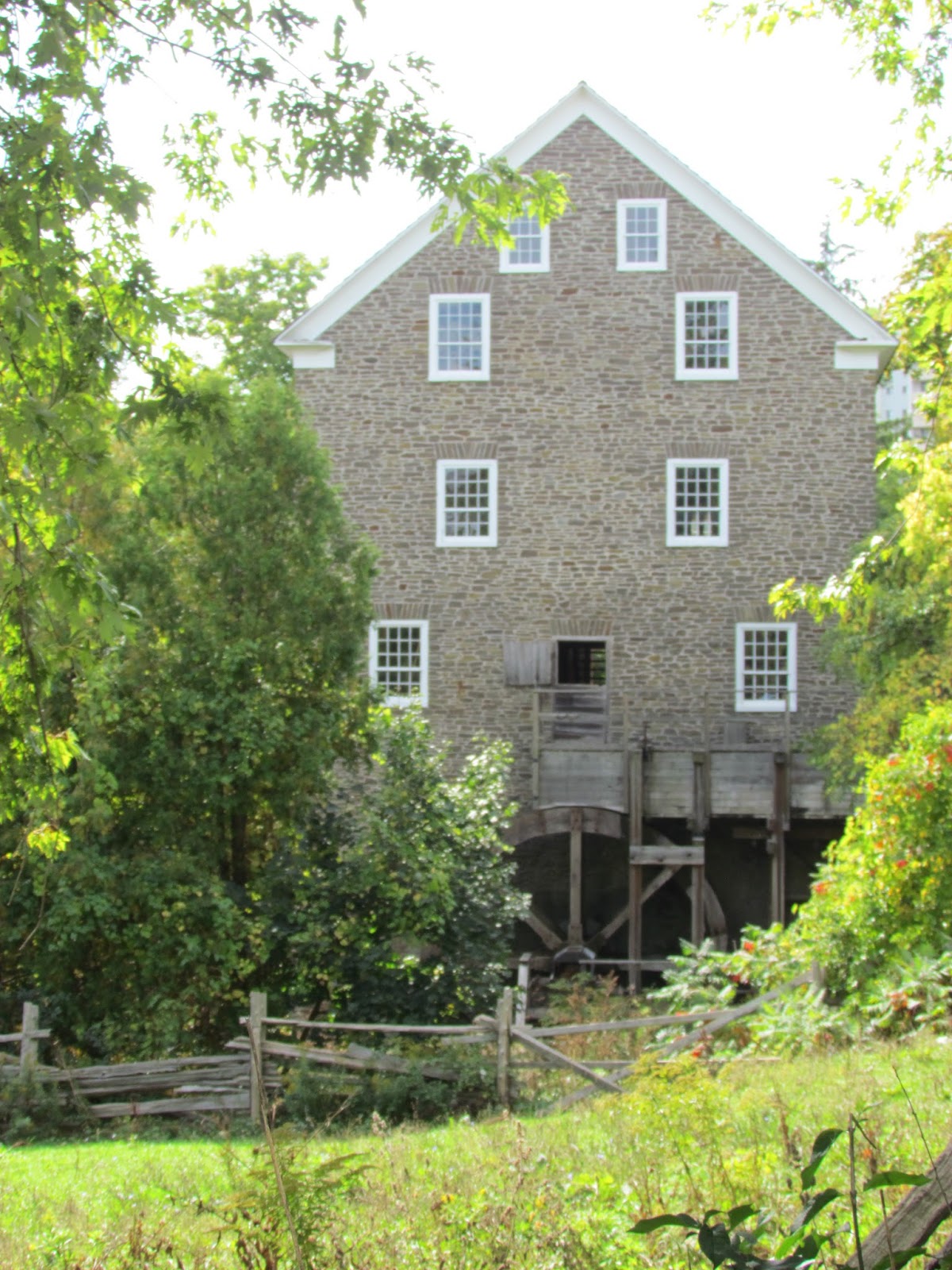
built by Owen Roblin in 1842
four stories high with a wrecked mill wheel
cumbered by stones and time
containing the legend of the Roblin family
and Taylor from Belleville who took it over later
Inside the gaunt skull-like stone remnant
dangerous black holes in the floor
as if someone had plunged down screaming years ago
worn-out machinery and great millstones
carved with lovers' initials
some of the boards nearly thirty inches wide..."
(from In Search of Owen Roblin by Al Purdy, 1974)

 Last week we made a pilgrimage of sorts, to visit Roblin's Mill at Black Creek Pioneer Village. Owen Roblin's mill. Al Purdy's mill. What's that you say?

Anyone who might have visited my other blog 'In Search of Al Purdy' (now dormant), or who knows of my involvement in the APAFA at a local level for awhile, will guess how important it was for me to finally see that mill. Here's a post I did back in 2013 which shows some historic photos of the mill.

This is the mill which inspired Al Purdy to write his long poem In Search of Owen Roblin; it resurfaced lots more times in his poetry and  prose.

For me this place somehow contains the history of the Roblin family, of Al, his work, Prince Edward County and its history - mine by extension -  and the architectural conservation ethic which raised it from a dangerous relic in a disinterested village to the centrepiece of a living history museum.
handsome cornice and eaves returns

In 1964 the original timbers, flooring and machinery were moved and set up at BCPV. The original masonry didn't make the trip to the city, and the replacement of soft old weathered limestone with something else creates a discord for me. Too crisp.

Somewhere I read (or did I hear him say it?) that PJS never quite forgave B. Napier Simpson Jr. for moving the mill from Ameliasburgh village.

In The Settler's Dream, Cruickshank and Stokes explain the necessity. "The tall chimney , of pink hand-made brick, towering high above the mills [belonged to the steam plant hastily built when the water supply from the lake slowed] came crashing down across the road early one foggy morning in the 1950s.
Edward was the last Roblin to operate the mill; he died in 1900. Several millers took it on subsequently, but by 1920, it had closed down. Plans to convert it into a canning factory were thwarted by the Depression and the obsolete building stood vacant for many years with most of its machinery still in place. In the early 1960s a serious crack in the masonry had developed and demolition appeared inevitable. The adjacent carding mill, with trim similar to the main mill, had already disappeared." (SD page 356/7)

In its new job, Roblin's Mill tells the story of c19 village life and milling very well. But for me, it's Purdy's poem that brings the place and the time alive. I like this passage in ISOR recounting the deadlock which finally slowed and stopped the giant wheel:

"And the story about the gristmill
rented in 1914 to a man named Taylor
by the last of the Roblin family
who demanded a share of the profits
that poured golden thru the flume
because the new miller knew his business
       and the lighting alters
       here and now changes
to then and you can see
       how a bald man stood
sturdily indignant
       and spat on the floor
and stamped away so hard the flour
dust floated out from his clothes
like a white ghostly nimbus
around the red scorn-"

a flume like this led water from Roblin Lake to the overshot wheel

Owen Roblin (1806-1903) Grove Cemetery Ameliasburg

If you have never read Al Purdy's long poem In Search of Owen Roblin, you must. Aloud.

I once read it out loud to myself on Purdy day, seated with my back against Owen Roblin's grave marker warming in the April sun.

Found something good that has never left me.

Lyre, lyre...

 Now this is interesting.
On Friday we wandered around an old stone area in Kingston, where I snapped this nice double house, loving the gardens and the ivy juxtaposed against the creamy Kingston limestone

A closer look revealed a keystone embellished with a relief carving of a lyre and the date 1880.  The house was across the street from a quite stupendous RC church. I made a mental note to do some digging, wondering if the home was affiliated with the church, and housed the organist or choirmaster at some point.


Then last night at an organ recital at Bridge Street United Church, that lyre again! I noted for the first time, the lyre in the magnificent stained glass west window above the tall pipes of the organ. The lyre, I have learned, has come to symbolize music in the praise of God. It's mentioned often in the Bible; Psalm 33 is a nice example.

just missed it...will get back soon to try again

Certainly praise was due last night. The inspiring sanctuary of Bridge Street United Church,  a centre for classical and sacred music concerts, hosted international virtuoso organist Janette Fishell in a very eclectic program. And Janette rocked the newly restored 1956 Casavant pipe organ.

Saturday, October 3, 2015

Just browsing... Princess Street

The economy cannot count on me. I'm past the age of acquisitiveness. I cannot afford my taste in personal adornment. My art budget is zero. I prefer my own cooking (most times) to restaurant fare. Books. Ah well, I do regularly make an exception for independent booksellers. 


But mostly, when I go to town, I wander, looking above the line of artistic shop fronts and BOGO enticements, getting in the way of real shoppers on a mission.


  I shop for built heritage. And thanks to my trusty Canon, I bring home plenty.

I browse for interesting details that I recognize from my study, or for puzzling bits that send me back to my bookshelf. And for that sense of travelling back in time to when life was lived in this 1850 stone store, or that 1890 house...that feeling I call resonance.
  They don't call it 'built heritage' for nothing. The buildings that we retain from our past contain the stories of the people who lived there, and their times.


 And I firmly believe that consciously or no, the reason people find shopping along Princess Street, or Walton Street in Port Hope, or in smaller spots like Bloomfield or Kleinburg so appealing, is that the treasure-filled shops are all the more inviting for being housed in beautifully preserved historic buildings.

Funny how cities and towns still don't get that.
 I'll pop back later to write a bit more about the wonderful buildings I've posted here.

I'm still busy unpacking all the treasures I brought home.

Just wanted to share some Kingston with you.