Ancestral Roofs

"In Praise of Older Buildings"
Showing posts sorted by date for query second empire. Sort by relevance Show all posts

Wednesday, January 1, 2020

Queenscliff is so Bracing

 This, for a lot of reasons.

Because I have kept company with la grippe for the holiday season, and have gone a bit barmy.

Because the Phillip Island International Challenge classic motorcycle races (with which himself is deeply embedded) are set to be run south of Melbourne in a bit over a month.

Because daily coverage of the terrible bush fires in Australia has my heart breaking, calling forth our short but intense visit in 2018, and the lifetime bonds it forged.

And because, in a monumental sort-out recently, I came upon the walking tour booklet Queenscliff, a Living History. And later, the website of Heritage Council Victoria. I have now left the building.
Queenscliff Inn 1905

Queenscliff was the first Australian town we visited after we left the PI track, a tiny ferry trip across Port Phillip Bay from Sorrento. And in the hot greyness, our first day together alone since the intensity of the races, we fell into Queenscliff and its history, in this 'Queen of Watering Places', elevated in the 1880s from its humble fishing village origins into a Victorian beachside resort. The general wealth-making and increasing mobility resulting from the discovery of gold in Victoria, spawned a place whose guesthouses, hotels and mansions remain, although its popularity had faded by the 1920s.


The first street we encountered, Hesse Street, was less than inspirational, although lunch at the 1905 Queenscliff Inn was refreshing and cool. A wander introduced us to the 1887 Post Office (looks more Edwardian Classical, but the guide confessed to many alterations) and the Vue Grande Hotel, which started out in 1881 as a grand Second Empire confection, rising from a 1927 fire as Spanish Mission.
Vue Grande Hotel  (1927 rebuild, Mission Style)
I'm enjoying Life in Victorian Britain by Michael Patterson. He blames Queen Victoria (and the railway) for the democratization of holidays at the seashore. Queen Victoria was a lover of the outdoors, and her seaside retreat at Osborne established a trend, among her subjects of all classes, for a seaside holiday.

Lodging in humble cottages, guest houses and hotels, Brits travelled the expanding railway system to Blackpool and Margate and dozens of other spots. Victorians on holiday - sensibly attired in corsets and big hats, white shirts and jackets. The only concession to holiday abandon might be a gentleman's straw boater. The bathers took to the water in bathing machines, a bizarre idea today. There's one below, restored at Osborne. Queen V's own.

It's fascinating but not surprising to see the trend playing out in Queenscliff, this very remote corner of 'the Empire.' I hope they dressed more sensibly. Queenscliff was in easy reach of Melbourne by rail by 1879, or by paddle-steamer.

I believe many of the cottages we admired were in fact permanent residences in their heyday, but give every indication of the holiday lifestyle now, with their lovely gardens and verandahs.

I found a statement of significance from the tactfully described "evolved... and not externally intact" Caribou Cottage, at 22 Gellibrand Street. It was built in the 1870s as a residence, but took a turn as commercial premises as well. Its rather over-sized classical fittings prompted this: "a highly decorated facade with a highly unusual composition, and somewhat awkward application of Classically-inspired detailing." How many cottages do you know with "vermiculated quoining", Classically inspired columns...and window architraves with keystone and projecting cornice?"

 The cottages along Gellibrand Street (the sea-view neighbourhood which includes a fort) have been modernized in some instances, their details removed. This craftsman style red brick/weatherboard appeals, with its brick-walled garden, as does the dainty metal roofed Victorian with treillage verandah and white picket fence nearby.


Some overgrown empty lots hint at demolitions, as do a few unimaginative new builds. The guide recalls that a row of nine cottages were built on the street in 1853/4 by George Admans for the Colonial Government, to house sea pilots, the health officer and his crew.


classic metal clad bullnose verandah roof


A street we did not venture onto, Stokes Street, is home to a gorgeous unspoiled 1890s streetscape of terraces and brick/weatherboard cottages - even a shop. Thanks for the return Queenscliffe visit Google cam!


Alas, there was not time to explore further; had an arrangement with our accommodations on the Great Ocean Road.

From sublime to ridiculous, and visits to three of the seaside hotels on Gellibrand Street, The Queenscliff Hotel, The Ozone Hotel (formerly Ballieu House) and Lathamstowe.
Queenscliff Hotel c1887
 Here's a tour of the area courtesy of Streetview.
 Imagine the street narrower, tree-shaded, strolling well-dressed pedestrians and the occasional carriage clip-clopping by and the sedate seaside holiday experience at one of these grand hotels.

The red brick Queenscliffe is "a very early and well-integrated Australian example of the English 'Queen Ann' architectural style." Cast iron balcony and verandahs, a polygonal tower with coned roof and bellcast shape, and most interestingly, the shaped Dutch gable reflecting, according to my heritage sources, northern European Renaissance style of France and the Netherlands.

The interior is said to be essentially intact. Didn't think to look.
Ozone Hotel (prev. Baillieu House) 1881-8

The former Ozone Hotel was built in 1881, a grand asymmetrical, two storey stucco-clad structure, with wings added in the 1880s. The so-Australian cast iron verandah and balcony, and four-storeyed tower with bellcast roof and iron cresting, announce its French Renaissance influence. A tony destination to be sure, but Queenscliff was fashionable with wealthy Victorian Victorians.

At the time of our visit in 2018, an 'executive apartment' was for sale, and today I found this advertisement for an STA. So, with the wealth floating around out there, might we be hopeful that this high-maintenance girl has a good future?


inviting entry


The prestigious Lathamstowe was built by a brewer, the philanthropic Edward Latham in 1882-3 as a seaside holiday home for Anglican clergy and their families. Heritage sources describe it as "a pair of Italianate residences in a duplex arrangement [identical facades on two separate streets] combined with a corner tower." There's a good photo from the corner, which I failed to get, here (a third of the way down the page.) Streetview also made the effort.

Another Italianate beauty in stucco covered brick. The form of the building, with two-storey semi-octagonal bays, arcaded loggias on two levels, the mansard topped tower with tripartite windows, bull's eye windows, slate roof and iron cresting, is matched by the detail. The fluted columns are of  cast iron,  topped with Corinthian columns.

Ontario  readers will enjoy this. I've just learned that the "Italian buckthorn" hedge surrounding the hotel is listed on the Victorian Heritage Register, despite its classification as a noxious weed. (Wouldn't happen here.)


 The roof is flat, designed for promenading and enjoying the sea view (the verandahs weren't enough?) Astonishingly they were clad in sheet (20 tons of it.) Water was collected and stored in underground tanks - was that a good idea?

Lathamstowe and Ozone hotels from Queenscliffe Foreshore Reserve

Before we leave Queenscliff, here's a link to a good post about Queenscliff history, and some great photos. Scroll to the last one to see why the town got its name.

the Needles, Isle of Wight in the short distance

Incidentally, if you wondered at all about the title; there's a seaside holiday link I'm enjoying today, having just opened a calendar of vintage railway posters, purchased at the National Railway Museum in York, for such a day as today.
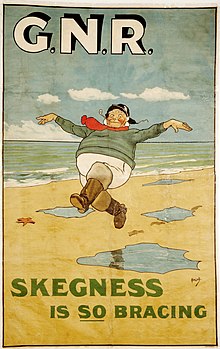
credit: Wikipedia


There is a treasure trove of wonderfully executed advertising posters commissioned by various British Rail lines in the 1920s and 30s, to encourage train travel to holiday destinations. Slogans like "It's Quicker by Rail" and "Skegness is so Bracing" are part of British life, and our home.

 Mind you, the iconic little Jolly Fisherman character skipping along the beach (by John Hassell, 1908) of the original GNR tourism posters (part of my man's Lincolnshire growing up days) looks dressed more suitably for our blustery April '19 family day on Mudeford beach, than for sunburn and donkey rides on the sand.


Wednesday, February 13, 2019

The Official Government Word

 It's time. Haven't been to Ancestral Roofs in ages. Christmas plague. A couple of months busy over Spring and Summer deadlines, in preparation for a late spring junket 'over home.'  Thought I'd take a minute to celebrate those most pretentious of Victorian homes, the Second Empire variety. This in honour of a borrowed book, inscribed "Presented to Glanmore House (sic) National Historic Site on the occasion of their twentieth anniversary 13 June 1993 from Bellevue House National Historic Site." Aw, nice. Museum buddies.


Second Empire excess has been on my mind lately. Glanmore, my 'other' house, was featured in the Winter issue of  County and Quinte Living. The splendid photos of magazine photo editor Daniel Vaughan showed the world how Glanmore does Christmas. I had a little something to do with it, also, she added modestly. In any event, the article (and editor Catherine's pointed remarks) brought a lot of people who "had been meaning to come in for some time" into the museum for all the Christmas splendour.

The book is one of a series produced by Parks Canada back in the affluent 80s. The burst of scholarship and publication arose out of the ambitious Canadian Inventory* of Historic Building, a well that has been tapped for a host of authoritative books on Canadian Architecture, such as The Settler's Dream, a local favourite.
*If you follow the above link you'll see that Glanmore's photo appears. Cred, to be sure.

I've talked about this series before: I'm fortunate to have collected titles in Neoclassical, Palladian and Architecture of the Picturesque (which requires stepping out of traditional 'style' names, a la Robert Mikel et al). I have just entered into negotiations with Abebooks to purchase a "some water damage but completely readable" copy for myself.

Because this copy must go back to the G'more reference libray. The title is Second Empire Style in Canadian Architecture.  The superscript Canadian Historic Sites identifies the series, I suppose, but it is missing in the other titles I own. Here's a review of the series; looks like the total was to include 7 titles. Wonder if they made it. I will check. "Hey kids, collect all 7!!!"

This book in the Parks Canada series is written by Janet Wright and colleague Christina Cameron. Cameron is listed as first author, but I recognize Wright's name from Architecture of the Picturesque on my bookshelf.

Parks Canada is a wide-reaching entity. I despair, and include this Wiki clip for your edification:

The Canadian Register of Historic Places is supported and managed by Parks Canada, in collaboration with provincial and territorial governments and other federal bodies. The agency is also the working arm of the national Historic Sites and Monuments Board, which recommends National Historic SitesEvents, and Persons.

It's puzzling that there is no biographical information about the authors. Faceless government functionaries. They're more gracious. I LOVE that in their Acknowledgements they "express their thanks to the many persons who added pieces to the puzzle with patience and enthusiasm." Among those identified is my friend, and acknowledged local old house expert, Lois Foster.


Another thing that appeals to me is that one of my very favourite (one, I hasten to add) Belleville SE houses, the buff brick at the corner of Charles and Bridge Streets, is the 'cover girl.' Had me puzzled for a minute, as the photo captures the Charles Street facade, whereas the  Bridge Street frontage is more familiar to OEH commuters.


Here's a Streetview view of the side the Inventory types preferred. They missed out on the splendid chimney, included above for your enjoyment.

I won't go on about Second Empire style, or the toothsome examples I've come across in my rambles, because, well, I've already gone on about them. If you've discovered the recently added Search function on the blog, you can readily call them up. If not, here's a link to several posts. Gad, I do ramble on, don't I?

Monday, October 30, 2017

I am not amused

Second Empire with NHS credentials 
I recently spent a week agonizing over dozens of architecture books preparing for a talk which didn't happen on 'house styles' (which I tend to think might better be referred to as stylistic influences, given the tendency for Ontario buildings to go all eclectic on us.) Blame the vernacular builder, the owner with dodgy taste who selects everything fancy to slap on, to the high Victorian Italianate/Second Empire piles who tended to share high style elements. Or later additions. Not a bit like train-spotting.


Gothic Revival
This we know for sure.
Second Empire.
Italianate.
Romanesque Revival.
Gothic Revival.
And so on.

I've read that most 'styles' express one of  two polarities - the stylistic see-saw between the popularity of influences from the Classical or the Gothic.

Regency

Greek Revival

Italianate

Shannon Kyles devotes a chapter to Victorian architecture on the Styles pages of her website ontarioarchitecture.com.

She explains: "a Victorian can be seen as any building built between 1840 and 1900 that doesn't fit into any of the aforementioned categories."


Markham


Victorian houses came in many sizes and shapes. A very common form was the L-shaped house, commodious for the large Victorian family and their entourage of relatives and household staff.


Hastings County

She describes that pleasing "mixing of styles", the bargeboards good but not Gothic, decorative but not historical. Gable designs feature not quatrefoils but sunbursts and starbursts. 

Shannon likens the craftsman's propensity for decorating every surface with as much variety as possible, to the Victorian dressmaker's art, which brought the art of over-decorating to heights never attained since.


The site lists features you'd see in any self-respecting Victorian home: "bay windows, stained glass, ornamental string courses, and elegant entrances."


Shannon Kyles points out that good craftsmanship was the hallmark; despite all those details, a pleasing "unity of design" prevailed.
Toronto Bay and Gable
 
Cabbagetown Cottages
 Bless those Victorians. No 'style' identification angst. Just sit back and enjoy them.

Monday, February 6, 2017

I Shall Return

This is silly, but when we took Power and Sail Squadron courses a decade ago, one subject that was drilled into our land-lubber heads was 'aids to navigation.' Good thing too, as one's safety, and the pristine condition of one's hull, depended on it. One mnemonic which sticks in my mind is 'red-right-returning.' The learning is that going upstream, returning to a harbour, the red channel marker is on your right.

The example at left is the entry to the lovely Trent Port Marina, in Trenton.

So this red/green tension hit me, when I looked at my photo below. This is another place I intend to return to. The day's fading light, biting wind off the harbour, and my need for that street tree to sport bright green all guarantee that. That, and my abiding curiosity about the place.

This is the Prince George Hotel, at 200 Ontario Street in Kingston. I vaguely recall that the first time we saw it, it was part of a movie shoot, playing the role of a New Orleans Hotel.

Historic Places provides copious detail on its appeal: "pre-1850 limestone commercial buildings integrated into a Second Empire mansard-roofed style hotel."The components range from a house built 1817-20 to a Victorian commercial terrace. Nice ashlar stone and quoins on the facade.

Streetview will have to stand in for  now. As you travel along the front, and up Market Street beside City Hall, you can detect the separate structures that were united into the whole that is the Prince George Hotel.

The hotel is featured as an example of Kingston's heritage renaissance in this Historic Places article.

One of the nicest things about the hotel is Tir Nan Og Irish pub.  Scroll down their Facebook page for some great Irish entertainment. And the menu ("elevated pub fare") is good too. My go-to is the chicken tikka masala boxty.

Soon as that tree at the intersection turns green...

Calling Card

Victorian visiting etiquette.
I've learned a bit about the formalities, and about many other aspects of Victorian life, during my volunteer years at Glanmore National Historic Site.
The lives of Victorian society ladies revolved around 'visiting.' Each lady would have her day to be 'at home' for other ladies to arrive for tea and dainties, consumed while attired in hat and gloves, sitting on the edge of their seats, bolt upright in corsetted and bustled elegance.
even Americans visited
On days when one just dropped in, one offered a visiting card to the maid who answered the door, and waited in the reception room to see if herself might be at home, and deign to pop down for a chat. If not, the card would be left on a tray in the hall, for later action.

These lovely mementos are part of a collection of visiting cards and post cards I received from our Pierce grandmother.


Their purpose is to announce our visit to Camden East last week and our intention to return, when the weather is more hospitable, for a walk down Queen Victoria Street to have a closer look at its lovely Second Empire home, and right to the end to this lovely skeletal barn with its brave little roof lantern.


Have I mentioned that Frontenac County is my new favourite place?