Ancestral Roofs

"In Praise of Older Buildings"

Friday, December 20, 2019

Gated Community

 Nice fence, I've admired it for years, wondering, between quick checks for slowing traffic and park-bound jaywalkers, just what those impressive buildings behind it must be. But something about that fence and gate always said 'not for the likes of you' and I didn't question.

Not long ago, in company with friend Jane, I slipped through the surprisingly open gate, and explored the grounds of the grand stone house beyond, dubbed, without too much effort, Stone Gables.

Before we leave off admiring the splendid gateposts and gates, of this fine expanse of cast iron and stone fencing along King Street, a word about the creator. The fence highlights the exclusiveness of the property at 462 King Street West, set back so far from the street, at Part Farm Lot 21, Concession 1. This is one of the large country estates that once lined King Street, the height of fashion in the late c19 and early c20.

Stone Gables is a large private residence built of stone in the 1920s, in the Tudor Revival Style.
It was home to Thomas McGinnis, a local construction engineer responsible for lots of projects at Queen's University - note the family resemblance? Have a look here, or other posts written about that time (remember, we're searchable.)


Why search for words? The Historic Places register says it best: two and a half storey, rectangular massing, irregularly coursed stonework, attractive window groupings, steeply pitched gable roof, projecting gabled frontispiece, prominent gable chimneys and hipped dormer windows, good craftsmanship in its exterior stonework, interior millwork and panelling, and glazing.

The colour in the fall trees, play of light and shadow, the feeling of separateness from the busy city street, the lake beyond -  they forgot to mention.


You can read more on the heritage sites about the associations with history - including the Federal Government's role in its use and preservation - though not maintance (especially evident at neighbouring St. Helen's) or adaptive reuse plans. Me, I'm just reliving a surprisingly warm late fall day in a lovely spot.
The south facade of Stone Gables (ignore the government issue fire escape if at all possible) shares the same position as St. Helen's, at the top of a rise overlooking the water. In Gables' case, infill housing has taken over the view, but the enormous trees on the site make it palatable. (I suspect that plan might work at St. Helen's, and wouldn't it be nice to channel some of the proceeds into restoration and maintenance?)

A colonnade and a second floor balcony atop a conservatory room suggest Gatsby-like summer revelry in this fine and private place.

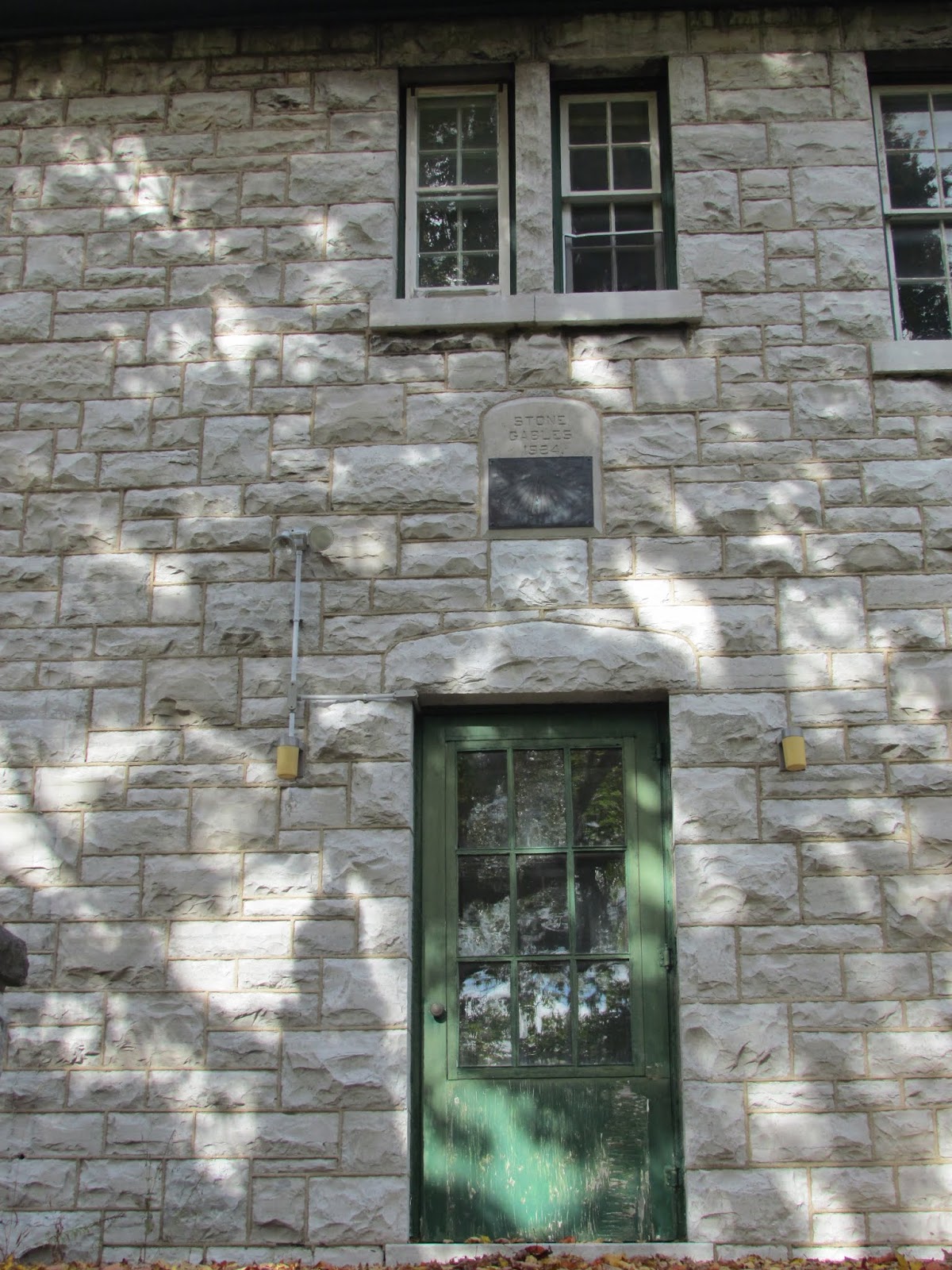
1924 datestone


The doors had Jane frothing with curiosity (and I thought I was a snoop.) Tiny entrances - little in the way of baronial entrance halls could be gained from determined peering at either entry.

The round-arched doorway is characteristic of the style, but the southern door didn't make sense to either of us.


The various heritage reports I've encountered online speak about the visual connection between the two houses. This view across the "landscape Regency gardenesque grounds" says it better than any government bafflegab can.


The somewhat blurry view of the east facade (they're far enough separated for me to run out of breath), taken from St. Helen's next door, highlights the connection between these two historic structures. Their loveliness makes the slowness/complexity of decision-making about their future frustrating.


Wednesday, December 18, 2019

Your Roots are Showing

Milford mill pond, Mt. Tabor church in the distance
One lovely day near the end of September I did something I had never done - walked from one end to the other, along every street and lane, of a village that one branch of the family or another has inhabited since 1786. Looking to make some photos for my Signposts column on Milford, I revisited well-known spots, with a new eye. And re-staked my claim to this place.


As it turned out, the photos were surplus to requirements, so I made them my own (since they were.) And unconstrained by any prohibition on first-person indulgences, I make Milford my own again. (If you want the fit-to-print story, the column appears here.)


I remember mom (nee Striker, of Royal Street) waxing nostalgic about the old Clapp-Scott mill on the western shore of the millpond - I think there was a Scott uncle and aunt living nearby, whom she visited as a girl.

a 1980s visit 
According to Murray Clapp's fine mill history The Mills of Milford, Ontario, 1800 - 1972, this mill is but a remnant of the 1812 mill complex developed by UEL entrepreneur Joseph Clapp on the upper falls of Black River (and a relation, as they say, by marriage, from the time the Striker diaspora began in 1786. The book The Stryker Family in America explains that ancestor Sampson narrowly avoided execution as a British sympathizer, forfeited his lands, and left for Sorel Quebec with his wife Ursula and her brother Joseph Clapp.) Mom had happy childhood memories of the old mill (sure would love to have her nearby to take a question or two right now); our family usually visited the upper falls during spring runoff ; our dad as drawn to the sound of running water as any beaver.


My article about the mill (part of a series) appeared in  County and Quinte Living (Summer 2013, p.61.) It was informed by Murray Clapp's fine book, and an interview with a passionate local volunteer, who was instrumental in saving the old mill, and much of the original milling equipment inside.


site of the Clapp- Dodge-Ellis mill, at the bridge

I grew up knowing that our family was connected in some way to the milling history of Milford. Through my maternal grandmother, born Helen Dodge, in Milford, I was connected to the one-time proprietor of the mill on the Black River, in the village. I remember our Sunday visit to grandma's house on Royal Street, the day after the abandoned frame structure burned in October 1956. I remember being fascinated by the smoking rubble, and the adults' shocked reaction.

Once again I wish mom were here to connect the dots, now that I want to know the family stuff. As kids, we were surrounded with a wide interconnected family, one's 'people', among whom one belonged and felt comfortable. I realize now that most of the familiar surnames that formed part of adult conversations, the faces at gatherings like card parties and church events, were those of folks related by blood or marriage to one or other of our parents, in that way that old families, in one county since the late c18, branched out through marriage. I remember occasionally having dinner with a family who was not 'related', and how awkward it felt.
former Knox, Pounder store
I wonder if this is part of the tension that sometimes appears between new people drawn to small communities for rural charm, and those who go 'way back', with deep history, feeling somehow marginalized by new people for whom those connections don't matter.

In recent memory there have been people creating new ventures in the old stores that were 'the big city' when mom and her siblings might have stood at the counter wistfully surveying the penny candy. These would have been stores patronized because of family connections or long association. All closed now, a new convenience store/bakery opened in VanCott's garage.

Dexter McKibbon's general store, then Chapman's Meat Market
I remember hearing the adults speak of Dexter and Manly McKibbon. I expect one or other of the local stores (Manly had a dry goods store, but it burned at some point) would have earned the grandparent's trade - although farm families likely bought little in the day.


advertising postcard


Dexter built a fine brick house (one of three brick houses I recall in the village, another being the Methodist Manse) in 1876, with the familiar projecting centre bay, bracketed roof, with verandahs at each side, and lots of lovely gingerbread. All gone now, replaced by an unlovely entry with vinyl windows and door. An extension at the back suggests a future as tourist accommodation.

A well-maintained 'twin' on a (the) back street was once owned by Fred and Julia Dodge, according to the Milford walking tour guide.

Grandma Striker was the daughter of Fenton and Augusta Dodge. I  have a tiny old photo of him driving a wagon load of milk cans. I wonder what the family connection is? I have a genealogist 'relation' - scion of the other UE Clapp brother - who would know. I once considered getting more involved in genealogy; it was she who warned me to fill the freezer with frozen ready meals before I began. I stepped back from the edge, shortly after this 2012 post.


This forlorn abandoned store has history. It was home to a succession of mill owners (the river and the mill were conveniently right behind the house): Clapp, Dodge, Ellis and Hicks. Most recently, it was the ice-cream stop on Sunday drives, operated by the third generation of Hickses. We stopped once with mom and dad, back in the '80s. Dad was aghast at the cost of the newfangled Haagen Dazs ice-cream bars.

Minaker's Garage will never die. It started as Horace Dulmage's machine shop, and was purchased by Bruce Minaker in 1925. It has done well ever since the Depression years, as a treasure trove of used auto parts. And a photographer's delight.

The old Clapp Cemetery was my resting place during the walk. A more practised eye was required to figure all the names and connections, but I touched my ancestor's stone, and breathed in the peace at the millpond shore.

A chin-wag with an old-timer (likely not much older than me) who remembered my 'people' along Royal Street, and bemoaned the Toronto ingress along his street, led to some reflecting on change.
This appealing hip-roofed structure along the pond shore is home to an artist, but was once an antique shop. It was on a visit with mom that I succumbed to Depression glass collecting (which didn't continue, as I didn't have the prices required - irony there?)

In recent years, history minded folks created a mural map on the east facade, well worth a stop. It recreates a 1912 photo of the village, when places like Dodge family bakery and the McNamara hotel and post office still stood.

Mt. Tabor across the pond
Mount Tabor Wesleyan Methodist church was dedicated in 1867, becoming a United Church in 1925, closing its divine doors in 1967. It reopened as a community theatre and event venue in 1984, and is still operating. It's the regal presence at the heart of the Milford fall fair. I don't recall ever attending services there (grandma's family were part of the South Bay flock) but recall (with horror, now) attending a 'donkey baseball game' once, at which no-one stood up for the dazed and confused donkeys.

marshy exit of the creek heading toward the lake
Despite the hazy heat and occasional barking dogs, I trudged down to the bottom of the dip where the road runs along the water's edge.Impossible to believe that small ships were once built here and dragged downstream to Black Creek. When I was little, the road southward curved around the edge of the limestone escarpment, emerging close to the top. Today it's the quiet oxbow of Chapman's Crescent, where not even Streetview dared to go.

Blame it on the winter bug I've succumbed to, this is more a blather than I intended. But I wanted to uncover some Milford layers, and perhaps I've taken you along with me. If you want more background, I revisited Grandma Striker's family house history in another story (same magazine, the following summer, page 48.)

Striker, Dodge, Clapp, Scott, Ackerman, Minaker, Welbanks, Hicks, Anderson, Ames, Hughes, Walker - genealogists know how all these connect. For me, it's enough to say the names. (Thanks, Al Purdy.)

Wednesday, November 13, 2019

Seeing in Colour

Friend and faithful AR reader Larry commented on the use of green in yesterday's post...ah, yes. Colour, when we had it. Today, November 13, our world is already smothered in snow - bright, crisp, beautifully lit by a conciliatory sun  - but snow.

Suddenly the earth is dormant, the heat usurped from the sun.

Which is why looking backwards (not so very far) to a wander around Portsmouth Village heritage district with fellow old building nut Jane is such a delight.
The buildings, the history, the topography sure. But the last of the fall colours in a clear fall light! Admittedly, it was a bit grudging early on, but burst forth enthusiastically in time for a waterside lunch at The Juniper, a short walk away.

The Portsmouth streetscape is so typically c19, front steps parked right at the pavement. I don't know if a bit of garden might have been shaved off to widen the too-busy street at one time. Sadly, for all their charm, individually or collectively, homes along King Street West must be just too noisy and dusty and, well, public, with the relentless traffic.

One charming (though likely frustrating to locals) feature in Portsmouth is the English village trick of trades vans parking two wheels up on the sidewalk to stay out of the traffic, effectively blocking both the path and the street. That feature, and the one-way system designed to calm some of the traffic, makes Portsmouth Village an ideal spot - for walking.


stone corbels, parapet chimneys, eaves


So much limestone to love. Jane's architect's eye spots things that get right past me, enthralled in my general wonder at the streetscape: unsympathetic chimneys, dormers, later expansions. But lovely with a touch of yellow.
lovely, with a past. Tall casements and a verandah?

 The village pump called out, but not too loudly. Coffee was the order of the day, and needs must. A national coffee chain, not especially sympathetically designed, was welcome, nonetheless.

Timber-frame decorated Portsmouth Tavern started life as Beaupre's (or Beaup's) across from the harbour and the penitentiary, in the 1860s. Bet this old place could tell some stories.
and just because, a gold car and an orange tree


funny how weedy ivy and sumac redeem themselves in fall
 More on these, to come.

industrial buildings at the shoreline


Tannery Cottage, with its bright orange door and window frames, doubtless belonged to the Maxwell Strange tannery (from 1855) at the foot of Mowat Avenue. Its loss by fire predated the takeover of the waterfront by high-rise apartments.


Delightful mid-century modern next door
 We end our junket where we began, stopping to admire the august parkside home on Kennedy Street behind.

This splendid red brick dates from 1818, and, as I explained in a long-ago post (link here) is the Gardiner house, which once stood at the water's edge, before some land reclamation took place.


It's now (if you'd care to look, here's Streetview pointing the way) sitting back of the historic town hall in Aberdeen Park, a good distance from the Portsmouth Yacht harbour across a do-not enter kind of parking lot.
Seen in profile, these houses are strikingly familiar. The red brick above has been researched and restored to give us confidence we're looking at an early c19 Georgian house.

The neat white double house at 140/42 just around the corner on Yonge Street is a relative. It's a double house, of 4 bays, but it doesn't take much imagination to see a former self. It's an old house, the limestone block foundation and giant tree give hints. But there are modern reproductions, which makes 'is it or innit?' a great game for  a walk like this.

No guessing here. This beautifully kept New England-y Georgian with tight eaves and a  stunning door surround is the John and Mary Pugh house, on Baiden Street, built 1860. Designation plaque says so.

Lovely Aberdeen Park (thank you community gardeners) and the village map which kept us scratching our heads for a while. No turning this baby upside down to get oriented.

In my first post about Portsmouth Village, almost 10 years ago, I mentioned Jennifer McKendry, Kingston historian, photographer and writer.

I'll close off this return visit with the suggestion that any ramble around this charming and historic place can only be improved by her wonderfully researched Portsmouth Village, Kingston: An Illustrated History.

 At the time of publication of the revised second edition, 2010, it would appear that she lived in the Pugh house, 1 Baiden Street. Couldn't think of a better owner.

Tuesday, November 12, 2019

Crosby, Still

A little over a year ago, July 2018 as it turns out, I explored some the self-described gems of the Rideau (although you wouldn't get any argument from me) thanks to a little pamphlet painstakingly researched and carefully printed by the good folks of the Heritage Advisory Committee of the Township of Rideau Lakes. Today I came upon this file of photos, and I love them still.

Although it's always tricky combining combing the horizon for architectural stories and keeping between the ditches, I managed to find a spot to pause and ponder the Robert Leggett Farmstead along Crosby Road.

The homesteader's story was played out on this hilly farm - a drumlin of rich soil, legacy of the glaciers - enough to produce some wealth, or at least the optimistic growth of a large barn quadrangle. It all started with a log house of course, in the way of such things. Then later, in the 1860s, a hopeful plain frame house.

By 1907, a fine brick foursquare house with a proliferation of dormers, and double enclosed porches obscuring some likely pretty fine brickwork. The guide suggests "an Ionic-style classic revival appearance." Not sure what that might be, but I suspect there could be some some Edwardian classical influences under all that verandah?

Couldn't get close enough to see the bell the guide describes either, but it's said to have been on the roof, for calling workers in for supper.