Ancestral Roofs

"In Praise of Older Buildings"

Friday, November 3, 2017

Cataraqui Village

just next door (see the Tim's sign?)
As I hopped out of my car on busy Sydenham Road on a July afternoon, I remembered why I had  avoided this bit of historic walkabout for so long. The traffic was hurtling by, ready to join the artery that is Princess Street, already in city mode. The allure of a quiet early village (for surely the resonance was there for me) was eluding them. Certainly the ever-widening arteries, the crazy-busy intersection (one definitely has to venture out on foot to appreciate this old place) and the Tim Horton's (which in fairness was nice enough to have a patio with umbrellas) made it easier to miss the nineteenth century vibe.
photo source forgotten


In fact, the village's worthy Beamish House across Princess street is completely inaccessible, shrouded as it is in trees (of course I would do the same were I six feet away from six lanes of traffic.)

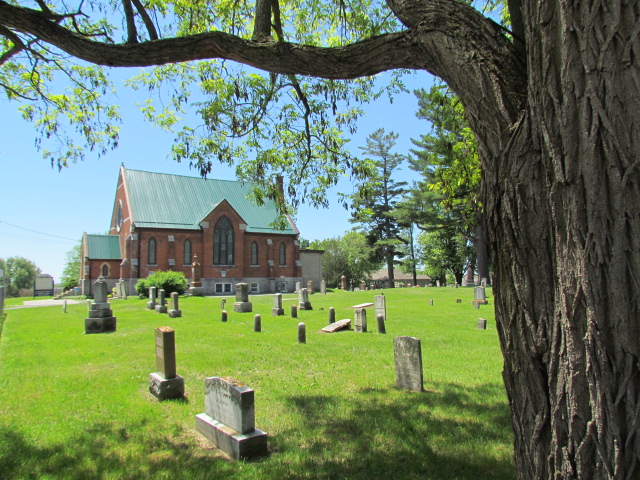
It should be such a quiet place. Two churches, two churchyards, an expansive rural garden cemetery with ancient trees and matching memorials. The feel of the long-ago village is apparent, once you're on foot, the white noise of traffic put aside. There's a mix of early houses higgledy piggledy up the hill, stone, frame, brick.


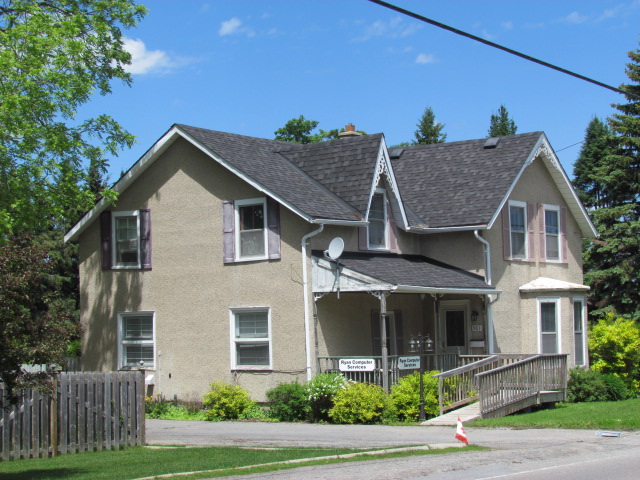
My personal favourite is this yellow frame house, with its rusting metal roof and brick end chimneys. The tall house with narrow footprint makes me think it's quite old indeed. It's being ignored, hopefully not until it starts to ring "eyesore" alarm bells and gets demolished.

It's clearly not the favourite of the tanned and well-dressed realtor with whom I chatted, after requesting permission to creep up his driveway for the photo above. The usual "owner not taking care of it, getting run down, want it gone" story. A realtor without a sense of place. Sigh. Glad I stopped when I did. The real estate office occupies the highest point of land in the village (clearly looking down your hill at the hoi poloi started much earlier) but its inhabitant had no house history to recount. Maybe a large farm home, nothing more.

Perhaps he's not aware how many gladly pass up sanitized suburban uniformity for the eccentricities of small old places, with stories?

And stories, Cataraqui has to tell. What makes this place feel like a village has to do with the survival of the 1847 town hall, and several still active early churches.


long view from the cemetery

The town hall has been repurposed as the Lions Hall. Its exquisite neoclassical doorway with elliptical fan transom, entablature with substantial cornice, pairs of fluted pilasters on either side of the sidelights is an eye-catcher, even if the Lions' team colours detract just a tad from the fanlight. About as much as the spiders vs. night-flying insect battlefield beneath the porch bulb.
Christ Church (1870, addition 1878)

Just as so much history is told in the acres of cemetery across the road, much is related in the graveyard of the red brick former Methodist Church, which replaced an early frame church built by the United Empire Loyalist faithful who had arrived in the area in 1784. A plaque in the churchyard brings long-ago stories alive. The grave of Michael Grass is here, as are stones commemorating the UEL refugees he led to this place, where they began again: "Day, Graham, Grass, Herchmer, Hill, McGuin, Powley, Purdy, Snook, Wartman and others."


1881 Methodist Church (now Cataraqui United Church)

In a post earlier this year, I walked the street of Purdy's Mills, across and down the hill from today's Sydenham Road. There you'll visit the plaques and gravemarkers of these earliest settlers in Cataraqui. I wonder how many of the houses still standing in the village, were built by their descendants?


Just as plaques tell stories, so do the simple utilitarian vernacular structures of the village. Let's listen to a few.

hiding something...red brick?
plain red brick L-shape 1880s farmhouse
unadorned but well-built (and maintained) stone cottage
a bit fancier red brick L-shape home

Kick and Push and other conversations - Yarker

Road trip season is winding down. Sigh. Although I have taken photos in wet November wind and significantly minus January temperatures (aided and abetted by my darling who kept the get-away car warm) I prefer those skin-temperature days of spring, summer and fall. So it's with considerable joy that I look forward to another season with my Lennox and Addington history friend.


 For the next while, looks backward must needs suffice. Like this one, a day in the recent past, when we explored a few limestone towns north of Napanee.

Another of those history portal towns is Yarker on the Napanee River between Colebrook and Wilton. Now, today we wouldn't stand for it (?) but in 1796  when the world was new, a thousand acres of crown land in the first concession of Camden came into the hands of York-based Governor Simcoe, and was dubbed 'the Simcoe Tract.'

A stone Italianate with deep eaves and decorative moulded cornice and outstanding paired brackets, caught our eye first. I didn't capture the facade, with its soulless modern replacement windows, nor can I recall the name on the dignified gatepost.

good stone house

A delightful local history compiled for the Historical Society in 1909 by E.R.  Checkley describes the Yarker area as "well wooded and well watered." For all that was necessary in the day was a watercourse falling down a height of land (26 feet at the time) and water powered industry popped up. Got me thinking back to my rambles around Newburgh along the same river.


originally Merchants Bank of Canada, early 1900s
The standard hard-won accomplishments followed: mills, post office, general stores, hotel, foundry and manufactories, electric light plant in the late 1890s. Another local historian, Fred Bell (in the same compilation) recounts that Yarker was at its peak from 1896-1912. 

I note that Peter VanLuven, whose name we encountered in Battersea early this year was  a mill owner in Yarker around the turn of the (last) century.

Yarker - well not at first. The village was first called Simcoe Falls and only later named for George Yarker, mill owner at Sydenham. Mr. Checkley recounts this scion of an old Yorkshire family, leader in Kingston society. won out over Pekin, Rockburg and several other obvious and not so obvious suggestions.

As we toiled uphill from the river, Jane recalled an impulse-buy from her university days, which fell through (likely a good thing.) The time was not right. The 1869 stone Methodist church is now a beautifully restored ivy-bedizened home encircled by fiercely protective hedges.  A fascinating thing about the church, is that the railway ran right along the front of the churchyard. Now the right of way forms part of the inviting Cataraqui Trail System.  Let Streetview get you oriented.
21 Cutler Road - school (1872/1896)
Another eye-catcher is the two-storey stone schoolhouse. Mr. Checkley recounts a one-storey stone school built in 1872, replacing an 1840s frame or log version. A second storey was added in 1896, and mirabile dictu, the derelict and boarded up school was purchased and restored as a home in the mid 1980s. Love these people.
photo courtesy Jane Lovell


Jane got to meet them on a local house tour. Her photo of the Victorian-flashy porch proves she got closer to this beauty than we did on our walk together.


what did this say, again?
great spot to grow up


scene/seen from a railway bridge


From the school/church intersection, we wandered along the trail, tempted onward by beckoning shade and the promise of a view of the river from the bridge. I want to return to walk more of the 100 km. system. You too? Here's a map to help you with your plans. The Cataraqui Trail runs along a former CN line from Smiths Falls to  Strathcona (a paper mill near Newburgh.)


bridge closed

former mill?


an active line
Railway history baffles me. In the early days, enterprising nation-builders in communities large and small financed all kinds of local rail  lines, connecting their towns to major rail transportation routes, and the hope of prosperity. Gradually the dreams died. Yarker was quite the railroad town.

In 1884, the Napanee, Tamworth and Quebec Railway, engine of progress, was inaugurated. Sold, renamed Napanee and Western, then Bay of Quinte Railway, and extended by lumber baron Edward Rathbun, it operated along the Kingston and Pembroke Railway track (E.R.Checkley)

Jane and Steven Manders
Lots of great books have been written about those heady days. Just when we had given up trying to put the story together, we came upon a fellow holding forth on the topic to a group, so we listened in.


And made the acquaintance of Steven Manders, railway buff, whose book First Spike celebrates (and elucidates) the early railways, canals and roads of the area. His particular favourite is the old Kick and Push. I love it for the name alone! Here's a link should you wish to shop.
'Flow of History'


Jane and I wandered all the streets radiating from the village centre - baffling by car. We found our way to the riverbank. We admired flower gardens and made friends. We ran out of daylight - and energy - before we had time to tell all the stories, talk to all the neighbours, take all the photos.


Napanee Falls - a 26' drop in the early days


We were badly in need of tea, but the former highly rated Waterfall Tea-room with the amazing relief 'sculpture' on the river-side wall, and the astonishing porch, is no longer operating.


This is where we left off, watching the river run. Perhaps this is where we will begin again, when spring warms the river.
a plaque bringing the glory days to life

Thursday, November 2, 2017

Repose

Isn't this a restful and inviting place? It's Glenwood cemetery in Picton . Local heritage-minded folk have recently devoted a great deal of energy to restoring the lovely 1901 funeral chapel with its crow-step gables. This Gothic revival miniature chapel is wrought of warm limestone, with beautiful stained glass windows, and a Gothic inspired turreted porch to set the mood.

A matching (even older) stone mortuary nestles into the bank just behind it.

Glenwood's 1901 chapel
Glenwood has all the requisite components of a Victorian garden cemetery. Topography - hills, valleys, water features, winding roads and the shadow-play of  light and majestic old trees. Victorian garden benches, for rest and contemplation.


I have always been drawn to Glenwood, escaping here for walks on visits home in my university days, when the small red brick town closed in. I didn't realize then that I was so calmed because Victorian garden cemetery designers planned it that way.

peaceful pathways lead to peaceful thoughts
Victorian symbolism
August Victorian memorials


Should you wish to read more about this unique and beautiful cemetery, I recommend Hearts We Leave Behind by PEC writer Margaret E. Haylock.


ancestors - mine, in this case
Masonic mysteries in stained glass


the City of the Dead
Another fine title,  Weep Not for Me, by Jennifer McKendry, features another nearby Victorian rural cemetery, at Cataraqui. McKendry has also published an in-depth cemetery study, Into the Silent Land,  which contains text and photos about both idyllic spots and a wealth of detail about Victorian cemetery design; the symbolism of grave-marker art especially fascinating.


A visit to local historian Peter Lockyer's History Moments Series I history vignettes will give you a mini-tour, to help you plan your visit.

Glenwood's cemetery manager and certified celebrant, Helma Oonk, will give you a tour, and assist you to plan eternity, should you wish.


forever At Home in Upper Canada


have a sit and a think


the grounds-keeper's home, shorn of Victorian features
a defunct water feature from 1910
 If you haven't been to this lovely spot, just GO. Bring your genealogy questions, and the thorough site plans will assist you in contacting the ancestors. Explore lichened monuments, and say the names that recount the area's (maybe your own) history. Enjoy a picnic or a stroll. You can be sure the Victorians did - for the garden or rural cemetery was the first public green space in many Ontario towns.

an illustrious inhabitant of the City of the Dead


I am looking forward to receiving the Autumn issue of ACORN, the magazine of the Architectural Conservancy of Ontario. Editor Liz Lundell was gracious enough to accept my article and photos about Glenwood and Cataraqui cemeteries, for the Remembrance-themed issue.
a place to honour and remember


Wednesday, November 1, 2017

Before and After Story

former  Excise Bonding Warehouse, Corby Distillery
One of the best Quinte region stories lately has been the transformation of the old Corby Distillery 'Canadian Government  Excise Bonding Warehouse' complex into Signal Brewing Company. Here's a link to their Facebook page, so you can (try to) keep up with the entertainment line-up.


So much to say. The repurposing of some beautiful historical brick and stone buildings is top of mind.

I spent a long time wandering the property on an only slightly promising mid-April day, preparing to write an article for County and Quinte Living about the Corby Distillery, way back in 2015.

I had already interviewed Helen, a mischievous woman who had worked at the once booming distillery back in the 1970s. So I shared her sadness at seeing this building (a holy of holies which she and her bottling line comrades were never to approach) with roof collapsed and vegetation taking over.

Along the river side of the building, a hazardous wooden bridge hinted at what must once have been a busy conduit between busy works-spaces.

Pallid post-winter nature did nothing to brighten the scene.

Fast forward to August 2017, when my guy and I finally visited Signal Brewery, after a delightful day at O'Hara Mill, and a photo trip around Hastings County's built heritage, for yet another story.

So much to delight. Our server explained the choice of name, Signal Brewing Company. Designer Carl Weins provides the fascinating back story to the logo and labels. The names: Signal, Radio Tube, Wave evoke nostalgic radio days, and embody the energy with which the place is crackling.


When you go, spend some time with the collection of Corby Distillery memorabilia in the foyer. Take time to fully appreciate the design decisions behind the creation of the interior event space which is already a legendary party and music venue (the bathrooms are gorgeous.) The staff are welcoming and attentive. There's also a terrific kitchen/menu, and a gorgeous multi-level deck overlooking the Moira River, and the beer. Ah yes, the beer. On our sunny Sunday afternoon D and I enjoyed flights of Signal's offerings, and watched the river run.

Naturally, it was the architecture I spent the most time with. The decor - post industrial funk, bare brick and stone walls, reclaimed barn siding and new sheet steel, smooth concrete floors. And the vision of the owner, Richard Courneyea, whom I interviewed for the article last year, when Signal was just an idea tickling his creative head.

This is a place to watch. Congratulations Richard  for your vision, your daring, your hard work. Signal Brewing Company is one of the area's best adaptive reuse project in years - and the most fun.