Ancestral Roofs

"In Praise of Older Buildings"

Friday, January 18, 2013

Love and Loss - Villeneuve Castle

looking up from Picton Bay
 Mom and Dad took great interest in the historic and beautiful buildings of their town. They were especially pleased to live on Bridge Street overlooking the treed hillside where stood the Castle Villeneuve.

They were 'first on the scene' with their Instamatic the morning after the explosion. Just recently I found these photos and wanted to share them with folks who still mourn the loss.


 In the 1986 propane gas explosion, a patron of the (then) restaurant was killed. The building could not be allowed to stand without some kind of retribution, and was quickly demolished.


The six acre property which slopes down to Picton Bay marina has been for sale forever. The Lester Group  which is handling it (one simply does not 'sell' a property this special) has assembled some of the history on their website. I guess in time the property will fill up with McMansions, and the castle will be nothing but a name...bragging rights.


It will always be there for me, part of the scenery we drove by on the way to 'town'.  I still remember the matching gatehouse which stood along Bridge Street. It stood for many years after the castle was demolished. I remembered to look recently and it has disappeared. Wonder how long ago?


Be sure to venture below this post, to read the heartfelt comment sent by the son of the then-owner of our wonderful Villeneuve.


Gone Walkabout

ACO Quinte area walking tours have been going on for a long time. I have just enjoyed reading a delightful eight-page account (a significant chunk of the 25 page Fall 1986 issue of ACORN) written by then Quinte Region president, the well-known heritage activist and writer Rodger Greig. He titles the article which describes tours of Glenora, the village of Roslin, and Cherry Valley, 'Lessons Learned from Walking Tours' and makes the point that "our buildings are on our streets for our education, enjoyment and use." Provided we are good citizens and stay on the sidewalk.

Sidney township but tour October 2012

On Sunday, January 20, at 2 PM at Bridge Street United Church, the AGM for the Quinte chapter of the ACO will take place (with cookies) in the meeting room of historic Bridge Street United Church. President for life (or so it doubtless seems to him) is David Bentley, with whom I worked for some years.

 David has been continuing the tradition of third-Sunday walking tours in the area.


Old East Hill walking tour 

These photos are from two of the tours in 2012 - a walking tour of the Old East Hill and a bus tour of some of the historic farms and buildings in Sidney township.

David assembles a tour guide for all these junkets; they are available at the archives of Prince Edward in Wellington. I have enjoyed exploring the back roads of Sidney township, following the instructions in a 1990 ACO tour itinerary, taking photos to add to the guides.


Kathryn enjoying the Corby Rose Garden
George and Denis 
David who makes it all happen

Sunday, January 13, 2013

Muscular Christianity

Canterbury Hall (1879)
Muscular Christianity. A idea which emerged during the Victorian era - physical strength and health married to the manly pursuit of Christian ideals in life and politics. A phrase which links these images of a very unusual church building in Trenton, and a glacial erratic found several miles north.

 But first...a few words about this polychromatic brick church, which has always caught my eye. Only a warm day last week brought me onto the streets of the town, to have a closer look. This is Canterbury Hall, built 1879 as the Sunday school and function hall for nearby St. George's Anglican Church. A picturesque Gothic revival building perched on a rise, it's an interesting style departure from its mothership, the 'English village' church in local limestone.

St. George's Anglican Church, Trenton
The brickwork is fascinating. Red brick creates bands across the facade, and follows the raking cornice of the gable. The exotic cross in the gable and the triangular motif depicting the holy trinity are unusual, conjuring mysterious lodge symbols. Diamond shapes, zigzags. The bricklayers were on fire that day.

Arches over the windows are flattened, Tudor style. Bricks are pressed into service to form decorative hoods over the windows.

And soaring overhead is a wonderful belfry pierced by a Gothic lancet arch opening.

Sadly, successive alterations to the front entrance have given the hall a perpetual dirty face. The building looks unoccupied. Graffiti are starting to add to the interesting facade. Uh-oh.


 And the link to the Bleasdale Boulder, that most muscular of rocks which rests where the glacier dropped it, in a lovely Conservation area on Highway 33? Reverend Canon William Bleasdale was the rector at St. George's from 1848-1889. The Reverend Canon supervised and volunteered in the actual manual work of building Canterbury Hall. And in his free time, this Victorian Renaissance man studied botany, astronomy, entomology and geology. Bleasdale drew scientific attention to the big rock in Glen Miller; featured on the scientific lecture circuit, it became a national curiosity - 'The Bleasdale Boulder'.

weighing in at one million kilos, the most muscular of Ontario rocks

Thanks to the LACAC notes resident in the fabulous Trenton library for the words to describe the wonderfully eccentric Canterbury Hall. And thanks to reference librarian Robert Amesse for making them available to me. 

Wednesday, January 9, 2013

Resonance - Port Britain style

Regular visitors to this blog know that I am always on about resonance, or echoes, the feeling you get that you have been transported back in time by a landscape or townscape, or an old building. Some places seem like portals inviting us to closer communion with the folks who once lived and died there. Lots of little villages, hamlets, or even ghost towns hum with the energy of times gone by, the domain of homesteaders, early industrial areas, empire-builders.
sadly, this 33 acre farm was for sale - future estate lots


For me, one such place is Lakeshore Road, which winds close to the edge of the bluff/beach of Lake Ontario, west from Colborne. From this winding road which respects the topography (no rock cuts or overpasses to make it an idiot-proof drive) and snuggles up to trees and fences, one can time travel. I won't say more. Just go.


Port Britain, according to an account by Ann King Sculthorpe at an ACO meeting in 1985, was settled in 1796 or '97 by a Samuel William Marsh, UEL from Vermont, who built the Port Britain mill.

The hamlet became a c.19 industrial village, its best years around 1856/7 when the harbour and Grand Trunk railway were built (and if you watched Downton Abbey on Sunday, you know what happened to that endeavour).
the rowlock bond cottage
There is a rowlock bond cottage on Jane Street, the road leading to the lake. The street was named after son Samuel Marsh's wife. Jane Ostrum came came from near Picton.

If this does not strike a chord with you, best visit 'The Settler's Dream', or wait til I post Row,Row,Row.

('Homesteads' by McBurney and Byers has an endearing account of their meeting).


 You might pass the hamlet  by, should your eye not be caught by the diminuitive scale of the homes set so close to the road.
  But in 1848, according to McBurney and Byers, "the community then supported more than three hundred and fifty people, including one wagon-maker, two blacksmiths, two coopers, two shop-keepers, two builders, a stonemason, contractor, stationmaster, harbou-rmaster, postmaster, teacher, veterinarian, innkeeper, fishermen and a tailor...[plus all] those involved in William Marsh's shipping and lumbering busines"s. p.208


I read somewhere that over 200 ship's masts were sold to the Royal Navy in one year. Which no doubt explains the absence of first-growth pine, also noted in Prince Edward County, due to the navy's enthusiasm for our tall straight trees.

perhaps this is the portal?

While my back was turned...

You know the feeling. When a tree which has always stood in a place is somehow removed, or a building that you were so accustomed to seeing is all of a sudden...gone. And you ask yourself, what was there? When did it go?

That feeling has happened to me lots on trips 'home' to Picton over the decades. Buildings succumbed, perhaps amid great furor, but on my return, just an empty spot, or a new building pretending it has always been there..."nothing suspicious here."

I recently received a wonderful gift. Actually, made a discovery. In a recycling box (well, you can't keep everything) I recognized a familiar magazine, in a former black and white iteration. I winkled several issues out from a pile of other discards, and am now enjoying ACORN, the newsletter of the ACO, from the 1985 to 1990 seasons.

There are so many stories to share, but today I am sharing photos of Picton buildings which were part of my childhood. At some point, when I was away, they disappeared. I am so grateful to the folks who fought on their behalf, and share their sadness at the losses.
The little building to the left is the Tecumseh Hotel, whose story was told by Gilles Miramontes in the Spring 1987 issue of ACORN. He makes the point that this corner of Bridge and Union streets was "the cornerstone of the original village of Picton" and emphasizes the importance of context, with this hotel and the (fortunately saved) North American hotel at the top of the town hill providing the visual anchors to the history and the townscape. The old Delhi  district with its coalyards was still viable (though shabby) when I was a girl.

from Spring/Summer 1990 issue of ACORN

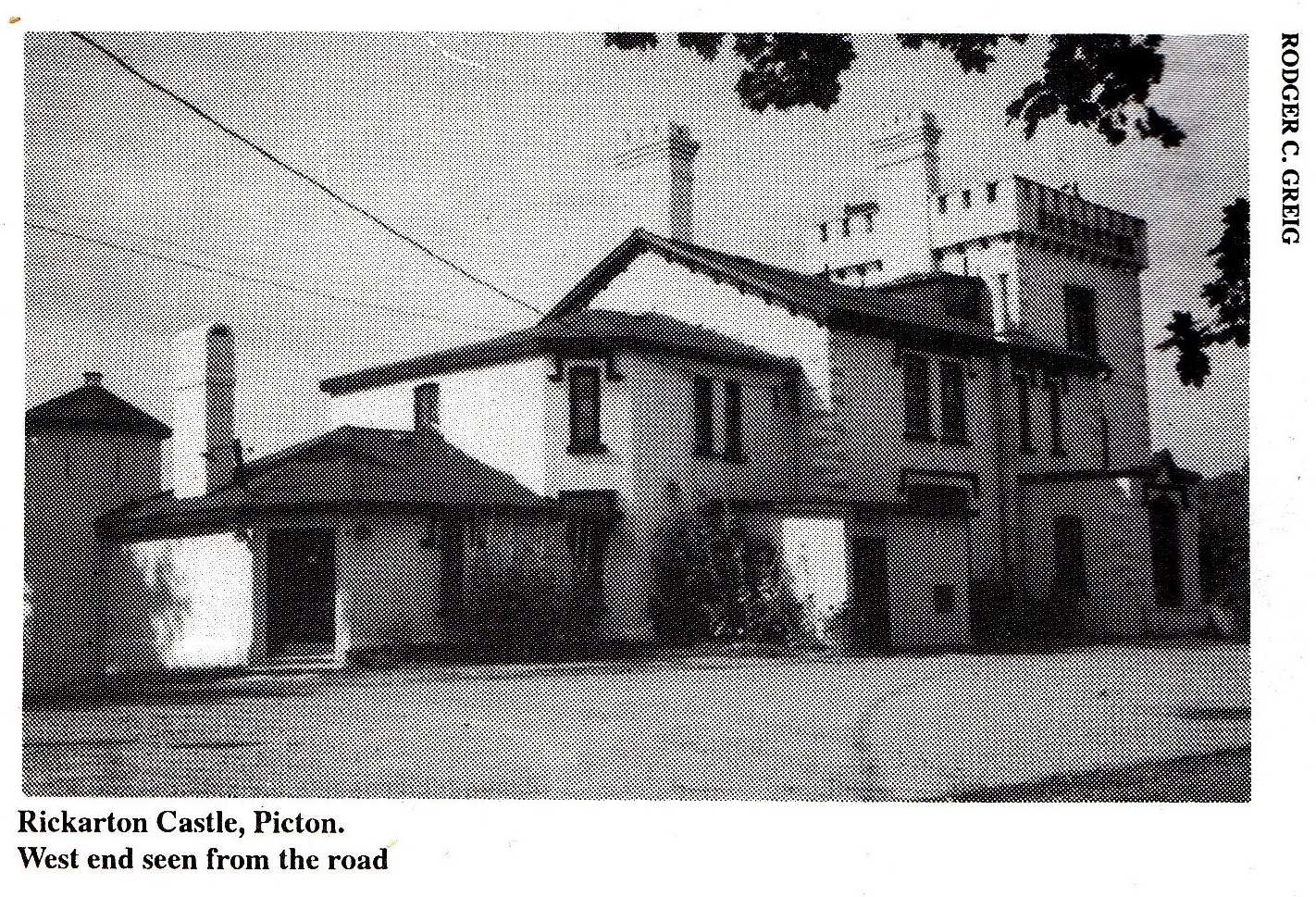
Rodger Grieg, a well-known champion of built heritage in the Quinte area, contributed his usual acerbic and knowledgeable take on the future of Picton's Rickarton Castle in the Spring/Summer 1990 issue of the magazine. He issued a dare of sorts to city council:
"It remains to be seen whether the town of Picton will have the moral fibre to hold on to this highly important landmark if, as some suspect, the new developer-owner chooses to think of removing it."

You think?

Picton had two 'castles' once upon a time.
In 1986 Castle Villeneuve was felled by a tragic explosion.
And then it was Rickarton's turn.
Does anyone remember the date?
My go-to girl for local history, my dear little mom, is no longer with us.

The bottom caption reads "A robbery is not a fair exchange"
from ACORN, Fall 1988
And finally, this building. On a visit in the late 80's I can remember mom proudly showing off the modern new drugstore, where I encountered a former classmate from S.S.#3 in her crisp white working smock. What I recall only now, was the butcher shop, Starks' Meat Market, which once stood in its place. As our farm produced meat for the table, we seldom had occasion to visit "Boney Starks" as he was (no doubt unfairly) nicknamed in some circles. What I never noticed, to my loss, was that the butcher shop was housed in a nice three story premises with a detailed brick frieze and eight Renaissance Revival inspired cast iron window hoods. As Greig puts it, "Heritage types like us are supposed to admire the re-use of [4 of the 8] iron window-hoods..." In the same vein, the editor comments that this might be considered "criminal facadism or Teaseling."  Never met Greig, wish I had. Clearly the man did not suffer architectural heritage fools gladly.


Sunday, January 6, 2013

Before and after


These two photos followed one after another on my screensaver slideshow.

I love the juxtaposition.

The first is found at Upper Canada Village, to which it made the trek in 1958. Originally, it was the 1825  home of the McDougal family of Glengarry County.


This confection with the ogee-arched entrance porch is the greenhouse in the gardens of Spadina House in Toronto, the home of financier James Austin and his family from 1866. The house and gardens are recreated as a museum depicting a  life the inhabitants of the home above could never have imagined, the life of the wealthy and privileged in the era between the two great wars. Think Downton Abbey series 3. Starting in 45 minutes, you say? Must dash.

Save our Schools


On one face, the 1919 Thunder Bay Technical Institute
they don't make 'em like they used to
ACO has long been active in attempts to save historic school buildings. The winter 1989/90 issue of ACORN (part of my dumpster discovery) is devoted to the Provincial Save our Schools Coalition and its conservation efforts on behalf of some very worthy buildings with great history.

Our summer 2011 camping trip to Lake Superior provided one photo day (unfortunately, it was the only rainy day on the trip, so this empty school looks appropriately glum). This astonishingly grand building  is the 1919 Thunder Bay Technical/Collegiate Institute. The building occupies a complete block - extra space needed for all this architectural grandeur! We found it interesting that the technical school opened on one street, the collegiate institute on the opposite side of the building, a block away. Was there a wall, a 'class structure', halfway through to separate the tech boys from the uni types?
The other side of the building, The TB Collegiate Institute


Old schools are vulnerable. We DO want kids to have warm shiny classrooms, with all mod cons, which results in those 'judgement of Solomon' moments. Why do we have to have them at the expense of lost heritage?
1915 Brighton Public/High School
2011 Brighton PS - photo from Board website


Despite determined activity by members of the East Northumberland ACO, the 1915 Brighton school (above) was demolished last year, and replaced by a shiny new school with some interesting stylistic echoes.


I worry a lot about this empty school, Trenton Collegiate Institute. Built in 1917, its library was frequented in the years between 1933-36 by no less a reluctant student that Canada's beloved poet Al Purdy. It was here that he retreated into the library, a habit of self-education he continued throughout his peripatetic life.

Despite this distinction, we all know school boards' reluctance to continue responsibility for redundant infrastructure. Watch this space.


And the little one-room school-house at the bottom? Folks who visit the blog may remember my old school, S.S.#3 North Marybsburgh, where I toiled through Grades 1 to 8 with the indomitable Miss Eaton. Interestingly, the shiny new consolidated school near Lake on the Mountain, which replaced it, has been empty for years, itself supplanted by the cheaper alternative of school-buses to town.