Ancestral Roofs

"In Praise of Older Buildings"

Saturday, August 22, 2015

Walkabout in Snarlington

A few weeks ago, while camping at Charleston Lake PP, I delved into Armand P. La Barge's newly published (Kirby Books, Bancroft) work Billa Flint: King of Hastings County.

One often hears the name Billa Flint in Belleville/Hastings County, associated with some philanthropy or business venture, but the book enabled me to finally connect all the industrious dots in this nation-builder's story. I'm hoping to do a post soon with local links.
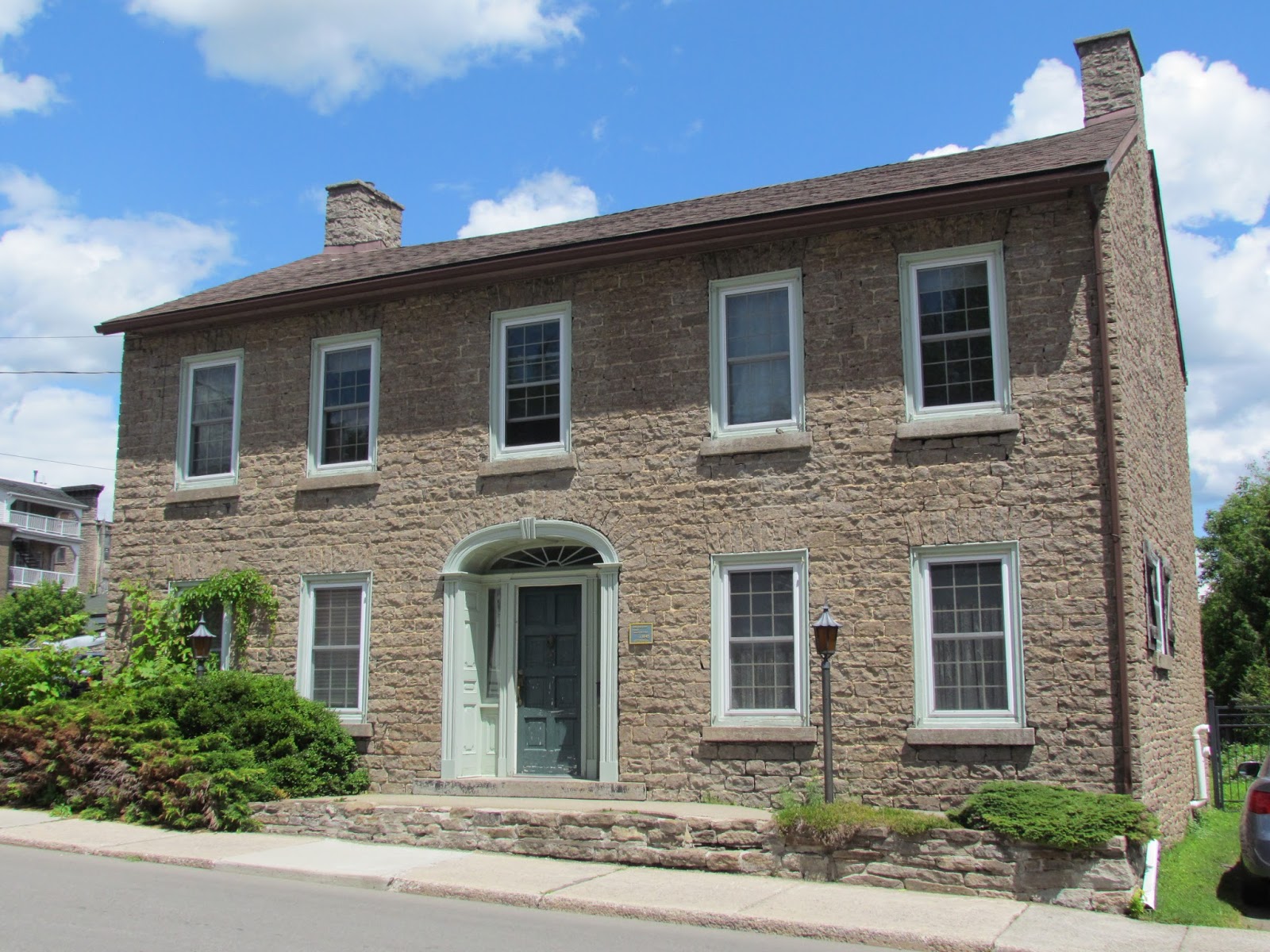
Robertson house (1852). Flint Street to the left

But there is an intriguing connection with Billa Flint in Brockville, and a walkabout in the oldest section of the city gave me an opportunity to explore his origins. Before he tired of his father's irascible drunken ways, and set out to seek his fortune in Belleville. Which he did.

 But back to Billa Flint Sr. In 2014  I met Curt Wheeler, when we both joined up with Tom Cruickshank's tour group visiting the restored homes (and church) of John and Diane Brisley in Prince Edward County.

(I've blogged about this dedicated couple on occasion, and shared their story in the spring 2014 issue of County and Quinte Living.)

Robert Shepherd Grist Mill 1853
Isaac Beecher House (c.1815/c.1840)
Curt added to the little bit I knew of Billa Flint's history. He reminded me that Billa Flint of Belleville (Actinolite, Flinton) was actually Billa Flint Junior. Curt lives in, and is restoring, the stone homestead of Billa Flint Sr. just north of Brockville. A huge and most worthy enterprise. Shortly after 1800 Flint Sr. established a store there, along the main road from Prescott to Kingston, eleven kilometers north of the river, in what likely felt like complete and utter wilderness.


Curt Wheeler hosts a FB group called Early Ontario Homes. Last time I looked there were photos of the stone house and barn of Billa Flint Sr., posted sometime in April 2014.


I was intrigued to read  La Barge's account of the Junior Flint's early life in Brockville, where his obstreperous father had moved the family and the family business after the end of the War of 1812.


 Brockville on the St. Lawrence was a booming town, although fractious. Sounds like the elder Flint's contemporaries might have been as contrary as he was. One of the biggest controversies in which town-folk were engaged was choosing a name for the place! Took them twenty years!

Names that were floated were Buell's Bay, or Williamstown (one of the early movers was Willliam Buell, who still boasts a street named in his honour.)


Charles Jones offered Charlestown. So much bickering took place that some wag coined the name 'Snarlington.' Fortunately, from the ashes of the war a hero emerged, and it was easy for all to adopt the name Brockville.
Robert Shepherd House c.1835
John Lafayette House c.1845
I had a wander around the old downtown section of Brockville along Water, Apple, and Broad Street, an old area hugging the river, where some early buildings still stand to tell the town's story. I followed a very early map indeed. 


John C. Potter House c.1833


A link to it can be found at blogger Doug Grant's  'Brockville History Album', a great site. It's William Buell's 1816 map of the city. On it, you can see the properties accumulated by Billa Flint Sr. And William Buell. And many of the old names still associated with places I visited, heritage walking tour guide in hand. (Around the Town, published by the Brockville Museum.)
Chaffey/McMullen House c.1834


Thomas Cunningham Store 1846

George Malloch House c.1840

The map shows a small piece of property under the name of Billa Flint. Today Flint Street runs beside it still, with a great hulking high-rise above it. He was an ambitious man; he'd likely be pleased.


This former commercial/industrial/residential area (no zoning obsessiveness in those get-ahead days) is calling me back already. There are still some old  doors inviting me inside, a few stops further along the walking tour of Brockville on the St. Lawrence.


Friday, August 21, 2015

Village Life

Can't tell you how wonderful the Pioneer Village at Lang, near Peterborough, is. Although I had wanted to go there for a long time, because of its association with a friend's story, I wasn't sure what I would find. One of those earnest local museums containing a hodgepodge of proudly donated treasures, lovingly displayed, but not especially well curated or interpreted, maybe.


We have spent many enthralled hours in such small museums, and admire the dedication of those who keep alive these vital links with our past.


 Lang Pioneer Village is not one of them. It is top-notch. Beautifully created, under the direction of one of Ontario's best restoration architects, Bruce Napier Simpson, Jr. Staffed by dedicated informed costumed volunteer village people.

A bucolic setting along Indian River, under Friendly Village trees (who remembers that reader from Grade 2?) Buildings moved from communities with which we have connections. Menie. Norwood. Keene.


Peaceful and uncrowded, yet there is a buzz. Creative and resourceful people, engaging events and programs.  At the time of our visit, a week-long fibre-fest was culminating in a special event, the grand ribbon-cutting opening of a massive rescued and restored Jacquard loom at the museum village's S.W.Lowry weaver shop.

The whole sheep to shawl story. Freshly shorn sheep in the orchard pasture (I swear they were unshorn when I visited early that same week!) A woman dying wool using plant dyes, in an iron pot on a crane over a smoky little fire outside the 1825 Fife Cabin (heard that name? Think wheat.)

Demonstrations of all the 'womanly arts.'


So many wonderful memories. I cannot say enough about the place: a treat for the senses, the memory, the mind, the heart. I do urge you to go. But they close for the season soon. Check out their superb website.


Thursday, August 20, 2015

Meet you at the General Store

Menie General Store (1858)
Lots has been written about the general store over the years since it disappeared.

I did a post back in 2012 about a favourite former general store, the Old Hastings Mercantile and Gallery in Ormsby. I met proprietors Lillian and Gary while researching an article for Country Roads Spring 2012 issue.

The magazine's editors Nancy and John Hopkins have a few back issues online, but not this one, alas.


The general store was vital to early communities, providing those precious items which the new homestead could not provide, from salt and tea, or goods not manufactured locally. Luxury items like fine china and factory made goods would have remained out of reach for most settlers.


The general store usually housed the post office for those cherished letters from home, provided financial services by way of barter and credit, and offered that most precious of all commodities to those folks living in relative isolation, human contact and news.

Last week, while camping in the Kawartha Lakes area, I finally had a chance to visit Lang Pioneer Village, and a general store whose story I had long known, and whose acquaintance I had been waiting to make. And, as did visitors to General Stores throughout our history. I got to experience some company and conversation.

The visit gave me an opportunity to remember my friend Florence and her sister Doris, daughters of Fogorig, a Scottish setttlement near Campbellford, whose story I wrote in County and Quinte Living in the Winter 2013 issue.


Doris and her husband Frank Potts donated the store, which Frank had operated for years in the tiny crossroads hamlet of Menie, to Lang Pioneer Village. The Potts were very active in local historical associations; it must have been a joy for them to see it restored in such fine fashion.


the window lit the second floor residence at one time
 'Storekeeper' volunteer Andrew was a delightful host. He recalled Doris and Frank Potts, and their donation of the store, its counters and cases, cash registers and customer account ledgers. The story of the original storekeeper, James Mather of Scotland, was recounted beside an excerpt from a map in Belden's 1887 atlas showing Menie.


We had a lively discussion about the 1899 recreation of the store and its contents, an outstanding collection of artifacts, merchandise which would have been available (while supplies lasted) at the general stores of the day.

Andrew shared an insight into tensions which were beginning in the communities by 1910 or so, when villagers could order merchandise from the new Eaton's mail order catalogue. Mind you, they would have to pick up their merchandise at the general store post office, which might have proved awkward (and the store owner might not be quite to quick to grant credit or do favours in future...)
the village setting at Lang

I had one of those pleasant  general store moments at Menie store. I was readying to take a photo, when a couple halted, to avoid entering my field of vision. We exchanged pleasantries, I bade them continue, and explained I knew the lady who had donated the building to the pioneer village. Turns out the couple did also! In fact, they live in a stone house in the store's former neighbourhood, a few properties away. Imagine. And we have been in touch.

Nice sociable things really do happen at the general store.


Wednesday, August 5, 2015

Deco Dilemma

Have you ever 'lost' a library book that you just cannot live without, to avoid having to relinquish it on the due date? No, me neither.

Not likely my conscience would let me, but I have in my temporary possession (6 days more and counting) one very good candidate for such larceny.


I've got it on Interlibrary loan from its home in King City library.

And nobody loves it like I do. It has been circulating about once a year since the author provided a copy of his 2009 work to that branch (and most others in the Toronto area.)


It's signed by the author, Tim Morawetz.


It's in that fresh new print smelling condition.


And it is the most authoritative book I've ever found on Art Deco/ Art Moderne architecture.


I love the language the author  has at his disposal, describing the details of the Toronto Deco buildings he features.

Pored over it with that "wish I'd said that" longing for his expertise.

The book is called Art Deco Architecture in Toronto. And it is not available anymore. Anywhere.


So. Here's the pitch. If you know of a copy lying underappreciated on a bookshelf, or in a used bookstore somewhere, do send me a line. Put Tim and me together.

Monday, July 27, 2015

Porch Fest

We're just back from a week of camping at Charleston Lake Provincial Park; had occasion to go to town a few times. "Town" in that part of the world is Lansdowne, about 10 km from the park. Their historic fair was in full swing as we drove through on our way north to the park. Tempted? Frankly no, but it seems everyone else was. Lansdowne has a great little supermarket, friendly post office staff, reliable free Wi-Fi in the library parking lot (important when one is tracking some important family news) and some really interesting architecture.
road-widening holdout
  Now, I missed one of the best parts of the town. Came about 20 years too late. I chatted with a dear elderly couple sitting on their porch where the sidewalk ends. Pop waved at passersby, Ma counted the train cars on the nearby CP line down the street ("150 cars on that last one!" she announced with pride.)
The Beatty house - female medical missionary's home
Pop recalled with sorrow the removal of the rows of mature shade trees which once lined the street, County road 3 heading up the hill to the town's confusing main intersection (now I know how newcomers to Picton's famed 'town hill' feel)  Road widening. Progress. For travellers like us. Felt complicit in the tragedy.


The most intriguing feature of the town is its porches. Not the welcoming 'come on up and set a spell' front verandah kind. Lansdown has those, but it also has a proliferation of second storey porches; they appear on residential and commercial buildings, adapted to Edwardian or ordinary front gable buildings.

Can't quite figure out their origin; they really give the village a unique character. Would I be correct in thinking French influence? Checked online and came across this page on Shannon Kyle's Ontario Architecture site. Remain convinced the Ottawa River French influence trickled down to the area; with a lot of help from vernacular builders over time.


A few bits of Lansdowne history exist online: it started along highway 2, but picked up its buildings and moved a mile north when the Grand Trunk Railway came through in 1856. There is a walking tour online (good on ya, folks.)


One thing I know for sure. Most of these buildings are over 90 years old, because Pop is
90-something and he can personally vouch for them.


Tuesday, July 14, 2015

Cake Decorating 101

Seems to me that Napanee must have had a house builder who specialized in decorative cornice friezes (or several copycat tradesmen.) I have often noticed these rich friezes, looking for all the world like iced confections,  on some of the town's wonderful Italianate homes.


Dropped friezes - wide bands below the roof cornice, lend these lofty houses an elegance that very few features can, panelled and ornamented to within an inch of their well beyond functional lives (their function being to support the roof brackets.)


Until this past spring, however, my admiration has been tempered by the need to keep the car from wandering onto someone's manicured lawn, or drifting through that tricky three way stop at Belleville Road and Bridge Street.


Finally I got a close look. Because May's installment of  ACO Quinte's entertaining and informative (and fiendishly difficult) architectural scavenger hunts, this one put together by Evelyn and Doug Sloane. The target? Napanee, a leafy and very interesting neighbourhood along Adelphi, Thomas, East and John Streets.


And although many of these cornice details were not on the scavenger hunt list of 36, for which my dear one was on a quest, I did manage to shoot a number of these very elaborate wide friezes. And what an astonishing array to select from, every way I turned.  Stokes and Cruickshank draw attention to a few details about the sheer Victorian excess of cornice friezes, in the glossary of The Settler's Dream.


Frieze decoration began with classical details, as one would expect, and blossomed into the large elaborate, paired brackets of the Italianate, with their acorn drops suggesting dripping icing just waiting for an impulsive child with itchy fingers.


Some of the photos illustrate the sorts of decoration which fills the vertical face of the cornice - applied detailing, panels outlined in moulding, the occasional example festooned with seasons of spiders' handiwork.


I was still spotting them as we followed the group down to the estimable Waterfront Pub along the river to cap off a terrific day.