Ancestral Roofs

"In Praise of Older Buildings"

Monday, October 2, 2017

Queensborough Day + 22

Well done citizens of Queensborough ! I'm sure you're still pinching yourselves. Months of preparation are behind you, and I'll bet you're still savouring memories of an outstanding community festival.

Katherine Sedgewick, daughter of the Manse, and one of the hamlet's faithful boosters, shared everyone's delight in a recent post on her lovable  blog Meanwhile at the Manse.

Three Sundays ago this charming hamlet celebrated its second Queensborough Open Doors day. I got to experience a bit over an hour of the event, due to the distances involved with making my way from Presqu'ile PP where I was camping, along several roads less travelled (and a couple of plain wrong turns!)


I was gobsmacked on my arrival, to see streets and the edge of the millpond lined with cars, groups chatting on the lawns and storefronts, people strolling higgledy-piggledy (put me in mind of a summer Sunday afternoon at Lake on the Mountain!) through the streets gussied up with flower pots and signage depicting the village's history in text and evocative old photos.


Two teams of horses ferried people to a number of destinations, where hosts shared even more displays of town and area history.

I encountered numbers of folks I know from history circles, and met many lovely people: folks whose roots go deep into the community, like the fellow from Ottawa, whose mom grew up on nearby Bosley Road, and Sally who was visiting to share the enthusiasm of friends who have recently become owners of the old Loyal Orange Lodge.


What a treat it was to walk up the gravel lane to the old c.1840 Daniel Thompson mill, to explore the riverbank and snoop around inside. The familiar wooden industrial equipment of early grist mills recalled my visit to the Mill at Piper Creek in Castleton, not too long ago.

And the resident cat, a charming young tabby, greeted all comers (including the wary dog Lucy) with just the right amount of proprietary aloofness.
Tweed and Area historian Evan Morton and an Ottawa visitor 

 I still cannot believe I crossed the threshold of this exquisite house and got to explore the main floor. Like the others crowding the centre hall, I was enchanted by a three year old who dropped to the carpet without prompting to remove her bright-coloured crocs, and tiptoed into the principal rooms of the c1850 Daniel Thompson house, now home to another Queensborough booster of many years Elaine Kapusta and husband Ludd.


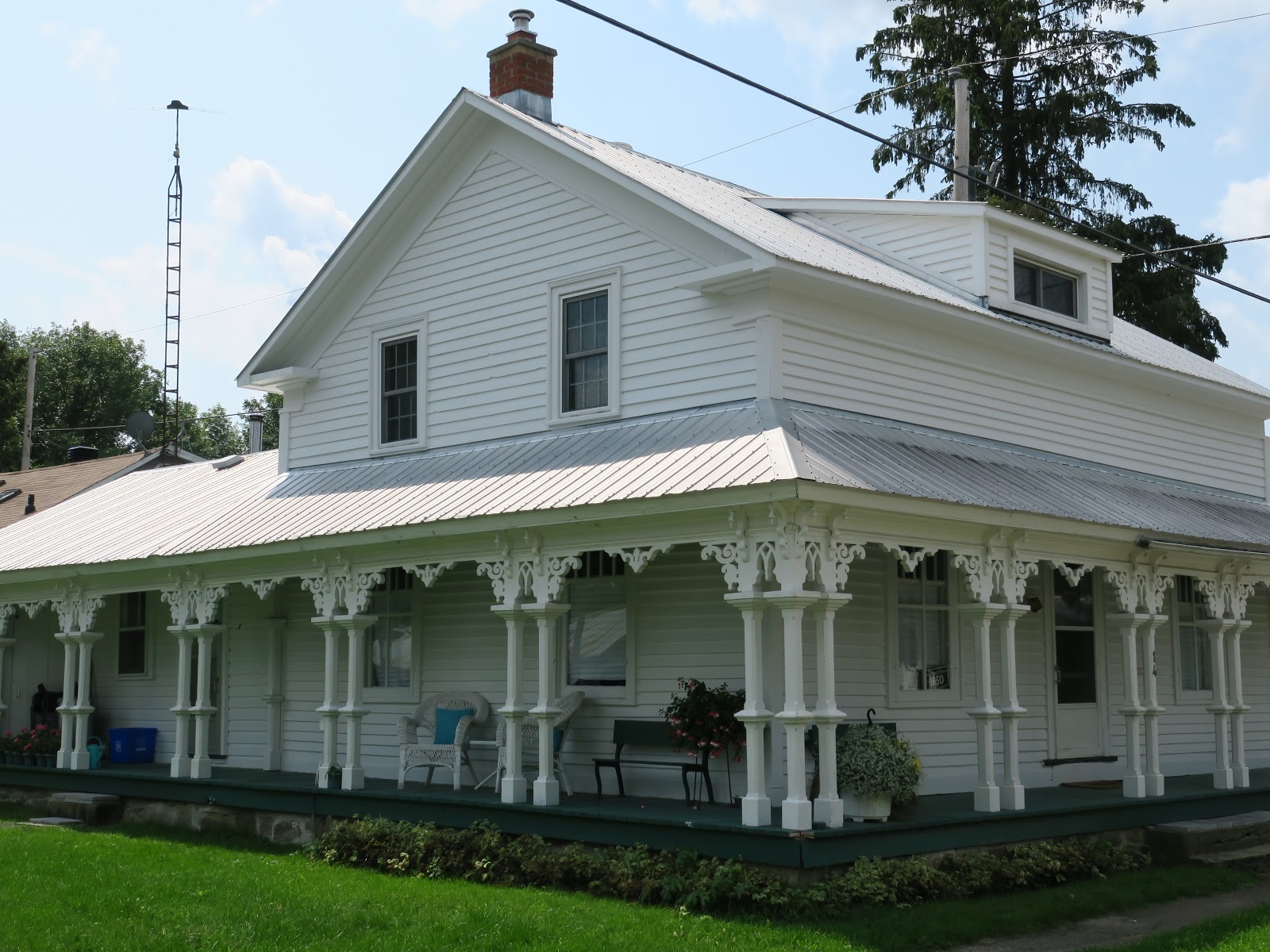
perfect Regency verandah

The walking tour guide produced by the local Community Centre is a treat; you can obtain one by email or phone. To assist you to plan your visit (because if you haven't been, you must), you can visit Queensborough's website or their Facebook page.

1854 American Hotel...

...later McMurray's General Store
I fell in love with this large frame building with Greek inspiration when I first saw it on a sleety November years ago. It's one of my Hastings County favourites.

By the way, it appears in the Autumn issue of Country Roads magazine,  one of 10 county buildings I photographed (and located historic photos of) which were already in operation by 1867.


Appropriately, I caught up with Sir John A and the missus in front of the hotel. They added the touch of class this tired but fine structure seems to need.

As all good downtowns should, Queensborough once had rival stores facing each other across the dusty street. This wonderfully maintained white frame building was once Sager's General Store, which closed finally in 1991, after many decades of serving the community.

Its story is told on the historic plaque standing on an historic foundation in the beautifully landscaped lawn. The store began its life in another building, as Job Lingham's store around 1840. This first store burned, and a second structure was moved onto the site. That building and addition housed both the Sagers and their store, and is now the home and residence of  Jos Pronk, machinist extraordinaire, and wife Marykay, two more of Queensborough's enthusiastic and hard-working boosters.

Methodist memories
All around the hamlet, places had been spruced up for the big day. A neighbour astride his 4-wheeler told me the story of the 1872 Methodist church which once stood at the top of now empty steps. I'm told it's alive and well in another community.

Later, Raymond (of the Manse) shared the story of a local teacher who died in WWI, whose initials can still be seen carved into the stone steps.
A streetscape rivalling Upper Canada Village - the difference is that these are real old neighbouring houses, with resident owners. The yellow house is Daisy Cottage, being restored by Julie, a new (and doubtless welcome) addition to Queensborough.

Next door, is the brown painted Kincaid House, one of the oldest homes in the hamlet. There's something so evocative about it. The photo shows Raymond (recent new owner) welcoming visitors.

For some reason (likely because I was deep in conversation) I missed taking a photo of the St. Andrews United Church Manse all gussied up for company. But you can read its story, starting with this 2012 post recording its purchase by Katherine and Raymond, on Katherine's blog.

The Orange Hall (1862)
New boosters have been added to the Q'boro team. Just recently, the rather decrepit Loyal Orange Lodge 437 has been purchased by a dynamic couple whose plans for the wonderful old building include a community cultural space.

Jamie and Tory have cleverly adapted the historical LOL (which sometimes evokes the nasty religious tensions in our past) into today's text message abbreviation. And for sure there will be lots of laughter in the old hall in time to come. Their clever sense of humour (and design) is evident in the logo sported by their pick-up truck.
original 16x16 sash windows
Here's a great history of the hall, in Meanwhile at the Manse.

Had a great day in Queensborough. The little village that could.

Sunday, October 1, 2017

Rapid Enthusiast


Somehow we've always missed Burritts Rapids. We've made return visits to Manotick and Perth and other stone towns along the Rideau. But not until we  established a Rideau River base-camp this past summer (sob) did we begin to explore the villages and hamlets along the waterway. On a day which began in Pierce's Corners (a quite impressive collection of early buildings to admire) we puttered along North River road, ending up at Burritts Rapids.

c. 1920 lockstation
1897 hand-operated swing bridge
Burritts Rapids is a hamlet bypassed by a busy County Road 2 (although those with 'the eye' might spot the early proportions of the two houses on either side of Burritt's Avenue, the route into the village.

The simple Gothic church is an eye-catcher, and the plaque-reader might be enticed to tarry. Just one look down the hill across the river and we were hooked.


This village without 'un commerce' as Queensborough friend Katherine has noted, may be lacking one of the engines of prosperity, but its unspoiled beauty (but for some declining structures) and early homes still much loved by its history-aware inhabitants keep visitors coming.


J.S.French house (1841)


Stephen Burritt, wife Martha and brothers Daniel and Edmund arrived from Vermont in 1793. The subsequent creation of the Rideau Canal turned his bush grant into a transportation hub, and his land was subdivided into town lots. Burritts Rapids provided the first bridge across the river.


The usual rags to riches to rags story ensued, with mills, shops and services springing up.


French's Forge - blacksmith shop
In one of those left standing at the altar events that happened to hopeful towns bypassed by the new railroad in the mid-1800s, Burritts Rapids lost its key transportation link status, and slipped quietly into....well, the hamlet slipped quietly into the little-changed truly delightful spot we visited this summer. Full of historic houses, canal-side structures, historic plaques, and welcoming folks.


J.Healey grocery store (by 1853)
A walking tour guide created by Pat Stroulger in 2005 opens the history book. Burritts Rapids walking tour is available online, so you can print one out and go see for yourself. See if you don't agree with us.

to the right, a past and future cafe


the exquisite c.1851 Stephen Hurd house

and driveshed

'Riverview' (1895)


George or Edgar Burritt (later verandah)

early log house

John Muir house (c.1859) donated for a school
the forge (c.1869) 


pressed metal siding and friendly signage
According to our guide, "by the mid-19th century the hamlet boasted several mills, a tailor shop, hat shop, two shoe stores, a bank, post office, two hotels and even a resident doctor."
J. Strahan general store/residence (1840)


along Burritt's Avenue


Another history adds telegraphic and daily mail, a bakery, a millinery shop, a tin and stove store, a grist mill, a woolen mill, a tannery, three blacksmith shops, three wagon shops, a cabinet shop, two churches, two schools and an Orange Lodge to the record of untrammeled growth of the hamlet.
An aside for apostrophe angst. Did this town founded by several members of the Burritt family not start out as Burritt's Rapids? And does the road out of town show as Burritt's Avenue? Then why do the maps show Burritts Rapids. (Don't reply. Rhetorical question.)

Christ Church Anglican (1831)

In spite of all that, don't you want to go? We want to return. Wonderful house history. A tranquil place along historic Rideau Canal. Lots of nature - a park, ancient trees, a walking trail. And the experience of island life. For Burritts Rapids became an island when those intrepid canal builders hacked a safe passage around the Rideau River rapids at this location 175 years ago. Quite the pick and shovel feat.

Tuesday, September 5, 2017

Queale Quality

Overthinking the shaped gables at Kemptville Agricultural College in a post just now reminded me of the pleasure I recently took, at finding time to contemplate this picturesque terrace along the Driveway in Ottawa. Numbers 304 - 312 Queen Elizabeth Drive are five units in this terrace just blocks from my down-at-heels student house on Patterson Avenue.


Queale Terrace, the brass plaque informs us, was built in 1912, for Ottawa businessman William   Queale. It's believed to have been designed by a New York architect. Adds cachet, I suppose, but this 5-family dwelling can stand pretty well, thank you, on its own merits. 

The plaque comments on the "sawtooth plan" which conforms with the curve of the driveway. Each unit is set back from its neighbour, so residents can enjoy front porch and second floor gallery (and the lawns and mature plantings directly in front) in relative privacy.

Better than having your own gallery has to be owning your own tower. Each unit has one, each with a bull's eye window and a different sort of cap - straight pyramid, shaped gable, bell-shaped dome, semicircular pediment and flared pyramid. (Thanks Andrew Waldron, for the language.) 


"the sawtooth plan"


Queale Terrace was built in 1912, as the area was becoming beautified by the Ottawa Improvement Commission. The Commission, created in 1899, was the precursor of today's National Capital Commission (NCC.) 


Here's a copy of a special Commission report from 1912. Photos of some of the new "improvements" are featured.

An astonishing photo on page 26 shows the newly opened barren subdivision along Monkland Street. Pages 37 and 38contain 1912 views of Clemow Street, a lush and architecturally rich neighbourhood today, bordered with twig-like new saplings. Bless the planners.